

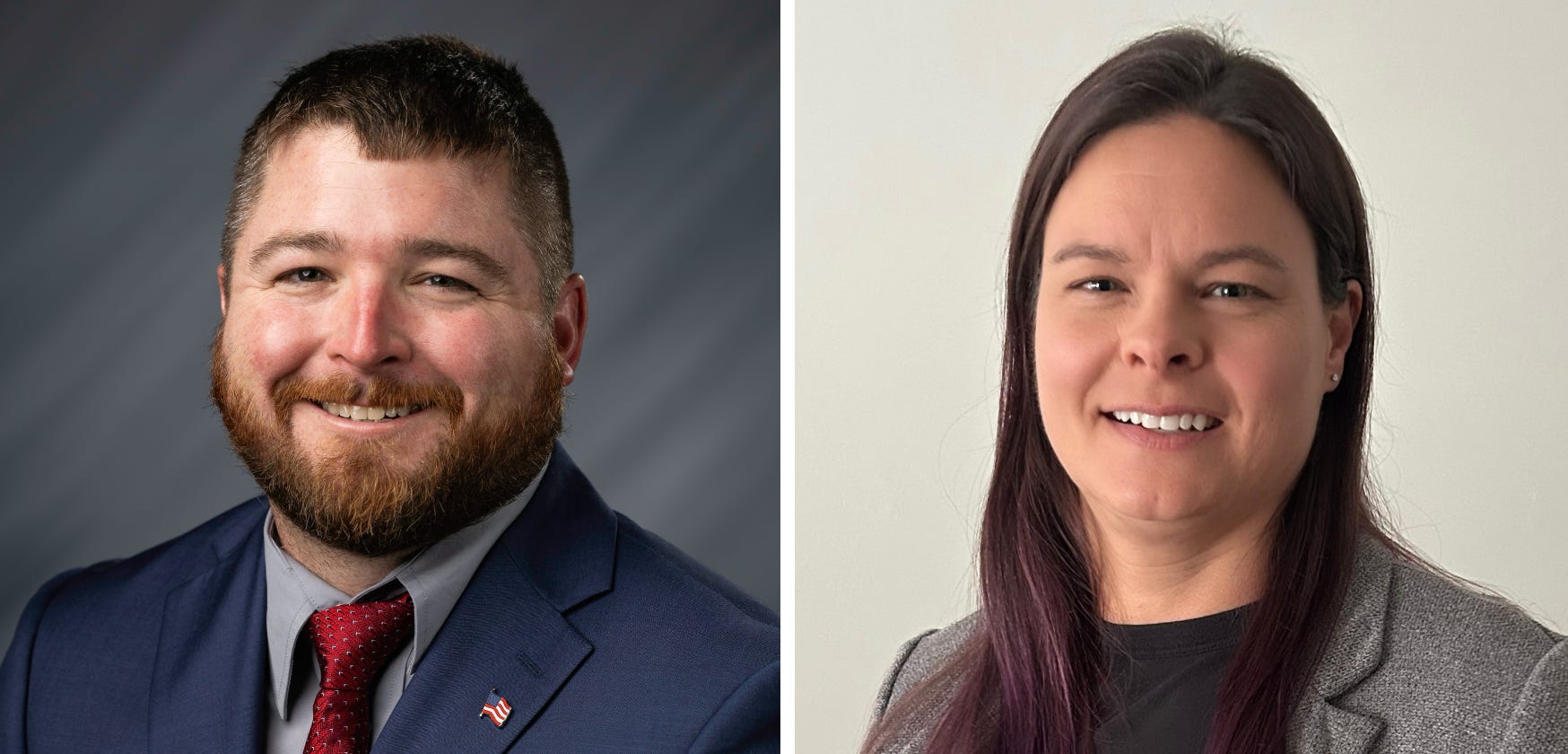
A pair of Democrats will be on the May 5 primary ballot for the party’s nomination to face state Rep. Matt Commons, a high school teacher and an Army combat veteran who won his first term in Indiana House District 13 in 2024.
Brenna Geswein, an engineer from Lafayette, faces Ed Moyer Jr., a retired educator from Hillsboro. Moyer lost to Commons in the 2024 general election.
House District 13 includes a large part of southern and northern Tippecanoe County, along with all of Benton and Warren counties, and portions of Fountain, Jasper, Montgomery, Newton and White counties.
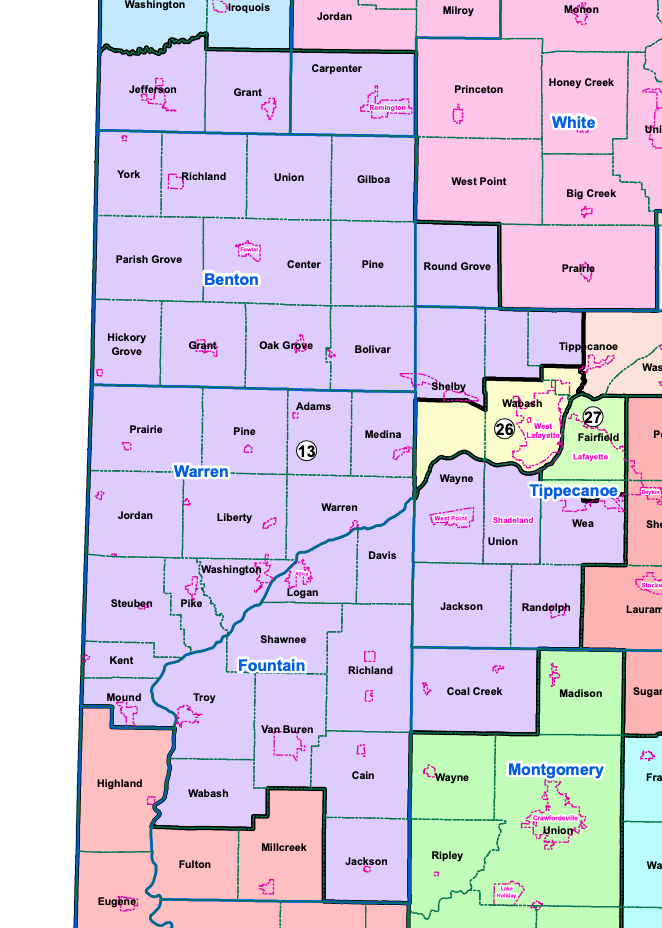
Here, candidates answer questions about their approach.
For more: Find bios of each candidate, along with information about where and when to vote, at the end of this article. Watch in the coming days for more candidate Q&As in other races on Tippecanoe County primary ballots.
Why do you want this job? Why are you running now for this position?
Republicans
Matt Commons: In the first 2 years, I’ve worked to deliver commonsense conservative legislation for District 13 and Indiana. We passed the strongest bill in the country to stop foreign adversaries from owning large plots of land, prevent foreign adversarial nation-owned companies from infiltrating our state tech and agriculture industries, and require stronger protections against foreign adversaries from lobbying in our state. We’ve also taken steps toward property tax relief and supported our students and farmers. I’m proud of that progress, but I’m running because there’s more work to do to cut taxes, reduce government, and put Hoosiers first.
Democrats
Brenna Geswein: I’m running for state representative because after 14 years of Republican supermajority control, our legislature is not focusing on the issues affecting most Hoosiers. Instead of addressing affordability, healthcare, and strong public schools, they’ve prioritized tax breaks for trillion‑dollar corporations and divisive culture‑war politics. We need leaders who bring people together and build community, not make budget cuts that harm our most vulnerable — children, seniors, veterans, the unhoused, and those with disabilities. These issues keep me awake at night. I am not a career politician – I am an engineer and mom ready to step up, be a voice of change and drive legislation that benefits all people.
Ed Moyer Jr.: Did not respond.
Name two of your top priorities for the position. And how will you handle them?
Republicans
Matt Commons: My top priority is protecting the rural Hoosier way of life. That means standing up for our farmers, making life in rural Indiana more affordable, and ensuring rural communities have a strong voice in the Statehouse.
Next session, I’m focused on improving rural healthcare access and housing availability. With only one hospital in the district, too many families are forced to drive long distances for care. The American Dream of owning a home has become harder to achieve. We need to increase housing availability by reducing burdensome regulations that hinder construction and lowering the cost of building materials.
Democrats
Brenna Geswein: Indiana public schools are losing nearly half a billion dollars this year alone because of the voucher program. In 2026, income limits disappear entirely, meaning taxpayer dollars will cover private religious school tuition for even the wealthiest families. Vouchers must be rolled back. Data centers like Amazon’s $12 billion New Carlisle project receive 50‑year sales‑tax exemptions and decades of property and personal property tax breaks. Yet in Indianapolis, about one‑third of Amazon’s 25,000 warehouse workers rely on public assistance because their wages aren’t enough to live on. Trillion‑dollar corporations need to pay their fair share in Indiana and we need to stop the triple tax-breaks they receive.
Ed Moyer Jr.: Did not respond.
How would you rate the property tax reform measures of Senate Bill 1, signed into law in 2025? What, if any, adjustments would you advocate in upcoming General Assembly sessions?
Republicans
Matt Commons: SEA 1 (2025) is a step in the right direction for property tax relief, but we have more work to do to ensure Hoosier homeowners aren’t taxed out of their homes. Hoosiers should begin seeing the initial effects of SEA 1 through lower taxes, improved efficiency, and greater transparency.
During my time on the County Council, it was frustrating to see that when one tax burden was lowered, the money was often shifted elsewhere instead of spending being cut. After years of inflation, Hoosiers deserve real relief, and local and state government needs to tighten their belts and reduce spending.
Democrats
Brenna Geswein: SB 1 was sold as homeowner relief, but it’s actually one of the largest business tax cuts in U.S. history. The new $2 million personal property tax exemption gives businesses the biggest benefit, while the lost revenue leaves schools, police and fire, EMS, libraries, parks, and road maintenance with fewer resources. To fill the gap, local income taxes will rise and those costs will be felt the most by younger, working Hoosiers. I support limiting the assessed value eligible for the homestead deduction so the new percentage‑based deduction applies only up to a reasonable cap. That approach restores some of the lost revenue without placing additional strain on families who are already struggling.
Ed Moyer Jr.: Did not respond.
What’s the best thing the Indiana General Assembly can do to improve access to quality health care? And how would you propose getting that done?
Republicans
Matt Commons: To improve rural healthcare access, we need a combination of deregulation, expanded telehealth, and solutions for individuals facing transportation challenges.
Recently, I was selected to serve as the Region 3 Legislative Liaison for the GROW Initiative. With the passage of the One Big Beautiful Bill, GROW will focus on expanding access to care in rural communities. We need to build on that progress and continue working at both the state and federal levels to ensure Hoosiers can get the care they need, no matter where they live.
Democrats
Brenna Geswein: Indiana needs to restore funding for public health through the Health First Indiana initiative. There was a large increase in state funding in the 2024 and 2025 budget cycle which was cut by over 80% for the 2026 and 2027 cycle. However, the 2024-2025 increase did not even bring Indiana up to the national average of per person spending on healthcare. Public health grants from federal agencies are directly related to the amount of state spending so it creates a compounded effect by not having a properly funded state health department. Revenue generation compared to budget allocations need to be holistically evaluated – many of the issues facing Hoosiers are intertwined and cannot be evaluated in silos.
Ed Moyer Jr.: Did not respond.
What would be the best thing, if anything, the state could do to solve what has been reported as a shortage of available, affordable child care in Indiana?
Republicans
Matt Commons: Childcare access is a real problem. We’ve seen federal dollars dry up, leading to closures. As a state, we should focus on cutting burdensome regulations and using targeted support where it actually expands access.
There are many unlicensed providers who won’t even consider vouchers because of excessive requirements and that has to be addressed. Simply throwing more money at the problem will raise prices without fixing the root issue. Childcare is also a workforce issue, and we need practical solutions that help providers operate and allow parents to stay working.
Democrats
Brenna Geswein: Access to quality childcare is crucial for Indiana’s economy yet state legislators have paused the Child Care and Development Fund (CCDF) vouchers until 2027 and implemented a waitlist which has grown to over 32,000 children. CCDF voucher reimbursement rates were also reduced, leading to over 200 childcare facilities closing. State funding should be expanded to ensure high quality childcare and living wages paid to providers (the median wage is $14.37/hour for our region). Childcare providers not being paid a living wage means 75% of lead early childhood education teachers rely on public assistance to support themselves. It is a vicious circle of dependency that can be broken through adequate public funding.
Ed Moyer Jr.: Did not respond.
Should the General Assembly do anything that makes it easier or more difficult, either one, for developers of data centers to find suitable places to build and operate in Indiana?
Republicans
Matt Commons: Decisions about data centers should be driven by local communities, not mandated by the state. If a community wants to welcome or oppose a project, that should be their right and we should never force development onto a small town against its will.
At the same time, I don’t believe Hoosier taxpayers should be flipping the bill for data centers. Data centers should not receive excessive tax breaks, such as sales tax exemptions and local abatements, at the expense of working families. These projects should be self-funded while respecting local input and protecting taxpayers.
Democrats
Brenna Geswein: Indiana needs to enact a statewide moratorium on new data‑center developments until their true impact is fully understood. These multi‑billion‑dollar hyperscale facilities are relatively new, and tax‑break laws need updated. We also need a clear assessment of the strain data centers place on our electric grid, the cost of new infrastructure, their heavy water usage, and broader environmental implications. Once construction ends, these facilities provide few full‑time jobs for the trade‑off in lost tax revenue. A pause gives Indiana the chance to study the impacts, update laws and regulations, and ensure that any future development actually provides long-term benefits to Hoosier communities.
Ed Moyer Jr.: Did not respond.
How do you rate the K-12 education system in Indiana? What’s one thing you’d advocate to make it better, and how would you get that done?
Republicans
Matt Commons: As a high school teacher, I’ve seen real improvement in student performance since COVID, though there’s still work to do. Overall, Indiana’s K-12 system is moving in the right direction, but we must continue preparing students for success after graduation - whether that’s college or the workforce.
That’s why I introduced legislation this past session to make it easier for students to access workforce training and career pathways. We need to continue expanding those opportunities so every student has the skills necessary to succeed after graduating.
Democrats
Brenna Geswein: Our public school teachers and staff are incredible – and every year they are asked to do more with less. Public school funding has not kept pace with inflation and school vouchers are moving almost half a billion dollars of funds to private schools for the 2025-2026 school year. Property tax cuts are further reducing schools operational budgets, meaning rural school consolidation and larger class sizes. I would advocate for elimination of the school voucher program so tax dollars are not being used at private schools. These private schools are selective on who they admit, are not subject to public financial audits or open school board meetings. Strong public schools build strong communities.
Ed Moyer Jr.: Did not respond.
What, if any, changes would you make to loosen or tighten Indiana’s laws on hemp-based products?
Republicans
Matt Commons: Right now, every gas station in Indiana is essentially acting as a dispensary, and that’s a problem. Hemp products are largely unregulated, with little oversight on what’s being sold or where some of the inputs are coming from.
This session, I authored HB 1274, which would have set a minimum age of 21 and required signage and ID verification upon entry. That’s the bare minimum we should be doing to keep these products out of the hands of kids and hold bad actors accountable.
Democrats
Brenna Geswein: Indiana should join our neighboring states in legalizing marijuana for both medicinal and recreational use. Doing so would keep tax revenue here at home instead of sending it across state lines. Legalization also brings regulation, which means required product testing and safer, clearly labeled options for adults who choose to use cannabis. Right now, the hemp‑derived Delta‑8 and Delta‑10 products sold in Indiana exploit a loophole in the federal Farm Bill. These products are lab‑created, largely unregulated, and not subject to the same testing standards as cannabis sold in licensed dispensaries. That lack of oversight raises concerns about product quality and potential contamination.
Ed Moyer Jr.: Did not respond.
If elected, you’ll likely have to navigate a Republican supermajority in both chambers of the General Assembly when representing your district. How will you do that, and what makes your prospects for success better than those of your opponent?
Republicans
Matt Commons: In my short time, I’ve built strong relationships with legislators across the state, which is critical to getting things done in a Republican supermajority. I have a proven track record of passing legislation across multiple policy areas — from taking the fight to China, to improving education outcomes, to increasing government transparency.
As the state representative for the most rural district, I work to ensure legislators understand the importance of protecting rural Indiana. I’ll always fight for policies that strengthen our communities and oppose those that threaten our way of life — no matter what party introduces them.
Democrats
Brenna Geswein: My engineering background has prepared me well to work across groups with different ideas and perspectives. I’m used to bringing people together, asking questions, and creating clarity so we can solve problems instead of talking past one another. I believe respectful discussion and a willingness to understand different viewpoints go a long way as oftentimes disagreements come from misunderstanding the issue, not from opposing goals. At the Statehouse, I’ll take that same approach. We need far less focus on Republicans versus Democrats and far more focus on addressing the real challenges Hoosiers face: affordability, healthcare access, and adequately funded public schools. My commitment is to work collaboratively, stay fact‑driven, and keep the needs of all people at the center of every decision.
Ed Moyer Jr.: Did not respond.
Name two specific things that separate you from your opponent and why those matter.
Republicans
Matt Commons: As a veteran, I proudly swore an oath to protect and defend the Constitution of the United States. As a state representative, that mission has not changed. I’m a constitutional conservative and will continue fighting to reduce the size of government, cut overreaching regulations, and lower burdensome taxes.
Over the past two years, I’ve had the great honor of serving District 13 Hoosiers. During that time, I took on China and our foreign adversaries, worked to improve student outcomes, stood strong for farmers, and promoted rural Hoosier values in the Statehouse. I’m proud of that work, but we have a lot more to do to protect our way of life.
Democrats
Brenna Geswein: I’m proactive about community outreach — knocking on doors across the district and hosting town hall listening sessions to hear people’s concerns directly. I’m naturally inquisitive and curious, always working to understand issues more deeply and expand my knowledge. That approach ensures District 13 has a state representative who makes fact‑based decisions while genuinely considering the thoughts and experiences of the people who live here.
Ed Moyer Jr.: Did not respond.
Candidate bios
Matt Commons
Party: Republican
Age: 35
Occupation: Teacher
Educational background: B.A. - Purdue University. M.A. - Liberty University
Past elected positions, if any: Warren County Council
Community boards or other community leadership and service: Youth Coach, Common Grounds Coffee Board, member of several veterans organizations
Immediate family: Alysssa (Wife) and two sons
Your campaign site online: www.commonsforstatehouse.com/
Brenna Geswein
Party: Democrat
Age: 45
Occupation: Engineer at Caterpillar
Educational background: University of Illinois: BS Mechanical Engineering and MBA
Past elected positions, if any: None
Community boards or other community leadership and service: Habitat for Humanity of Lafayette Board Member (2016-2022), current financial coach and Women Build team captain. Leadership Lafayette Graduate - 2016.
Immediate family: Husband: Shawn Geswein, Air Force Veteran and employed with MacAllister Cat. Two sons: Joshua (20), Purdue sophomore and Air Force ROTC cadet, and Zachary (17), Harrison High School junior. Four adult step children with six grandchildren.
Your campaign site online: www.ElectBrenna.com
Ed Moyer Jr.
Did not respond.
ABOUT THE MAY 5 PRIMARY
Early voting ahead of the May 5 primary election runs April 7 to May 4 with contested races on Tippecanoe County ballots for U.S. House, several Indiana General Assembly seats, Tippecanoe County commissioner and Tippecanoe County Council seats, township position and state convention delegates. Voters may choose a Republican or Democratic ballot, but not both, when checking in at the voting site.
Voter registration/ballots
To check your voter registration and to see candidates who will be on your R or D ballot, go to the Secretary of State’s portal at www.indianavoters.com.
Early voting sites
In Tippecanoe County, registered voters may cast their ballot at any vote center.
April 7 to May 4: Tippecanoe County Office Building, 20 N. Third St. in Lafayette. Weekday hours: 8 a.m.-4:30 p.m. April 7-10, April 13-17, April 20-24, April 27-May 1. Other hours: 9 a.m.-4 p.m. April 25 and May 2; and 8 a.m.-noon May 4.
April 18: McAllister Recreation Center, 2351 N. 20th St., Lafayette. Hours: 9 a.m.-1 p.m.
April 21: Córdova Recreation Center, 355 N. Martin Jischke Drive, West Lafayette. Hours: 10 a.m.-4 p.m.
April 23: First United Methodist Church, 1700 Mitch Daniels Blvd., West Lafayette. Hours: Noon-5 p.m.
April 25: West Point Fire Station, 4949 Indiana 25 S., West Point; Otterbein United Methodist Church, 405 Oxford St., Otterbein; and Clarks Hill Christian Church, 9510 Pearl St., Clarks Hill. Hours: 9 a.m.-1 p.m.
April 28-May 1: Tippecanoe County Fairgrounds, 1406 Teal Road, Lafayette; Wea Ridge Baptist Church, 1051 E. County Road 430 South, Lafayette; Eastside Assembly of God, 6121 E. County Road 50 South, Lafayette; and John Dennis Wellness Center, 1101 Kalberer Road, West Lafayette. Hours: Noon- 6 p.m.
May 2: Tippecanoe County Fairgrounds, 1406 Teal Road, Lafayette; Wea Ridge Baptist Church, 1051 E. County Road 430 South, Lafayette; Eastside Assembly of God, 6121 E. County Road 50 South, Lafayette; and John Dennis Wellness Center, 1101 Kalberer Road, West Lafayette. Hours: 9 a.m.-3 p.m.
Election Day vote centers
Voting on Tuesday, May 5, will be 6 a.m.-6 p.m. Registered voters in Tippecanoe County may choose any of these sites.
Lafayette
Tippecanoe County Fairgrounds, 1406 Teal Road
Lafayette Community Church of the Nazarene, 3801 Union St
The Grove Covenant Church, 3600 S. Ninth St.
Tippecanoe County Historical Association History Center, 522 Columbia St.
Wea Ridge Baptist Church, 1051 E. County Road 430 South
Eastside Assembly of God, 6121 E. County Road 50 South
Northend Community Center, 2000 Elmwood Ave.
West Lafayette
Faith West Community Center, 1920 Northwestern Ave.
Córdova Recreation Center, 355 N. Martin Jischke Drive
Connection Point Church, 2541 Cumberland Ave.
John Dennis Wellness Center, 1101 Kalberer Road
Outside Lafayette/West Lafayette
Shadeland Town Hall, 2485 Indiana 25 West, Shadeland
Tippecanoe Township Volunteer Fire Station No. 2, 448 W. County Road 650 North, West Lafayette
Dayton Gathering Point Church, 7201 Wesleyan Drive, Dayton
Battle Ground Fire Station, 112 North St., Battle Ground
On the ballot
Here are candidates who will be on Tippecanoe County ballots in the May 5 primary. (* = incumbent)
Tippecanoe County
Commissioner, District 1: Julie Roush and James Waters, R; Andrea Burniske, Travis Dowell, Justin Kendall and AR Lane, D
County Council, District 1: Ben Murray*, D; Trent Richter, R
County Council, District 2: Jody Hamilton* and Jonathan Chapin, R
County Council, District 3: Lynn Beck, R
County Council, District 4: Lisa Dullum*, D
County Clerk: Abby Myers and Carrie Sanders, R; Karan Benner, D
Assessor: Anthony Hustedt-Mai, R; Kaitlyn Butler, D
Auditor: Jennifer Weston*, R; Eric Grossman, D
Recorder: Kristy Martin*, R; Monica Casanova, D
Prosecutor: Jason Biss, R
Judge, Superior Court 1: Kevin McDaniel*, R
Judge, Superior Court 2: Sarah Wyatt, R
Judge, Superior Court 4: Matt Sandy*, R
Judge, Superior Court 5: Kristen McVey*, R
Judge, Superior Court 7: Dan Moore*, R
Indiana General Assembly
House District 13: Matt Commons*, R; Brenna Geswein and Ed Moyer Jr., D
House District 26: Chris Campbell*, D; Magdalaine Davis, R
House District 27: Sheila Klinker*, D; Tracy Brown and Oscar Alvarez, R
House District 38: Heath VanNatter* and Mark Hufford, R; and Nate Stout, D
House District 41: Mark Genda*, R; Jackson Hayes, D
Senate District 22: Ron Alting* and Richard Bagsby, R; Natasha Baker and Marlena Edmondson, D
Senate District 23: Spencer Deery* and Paula Copenhaver, R; David Sanders, D
Congress
U.S. House, District 4: Jim Baird*, Craig Haggard and John Piper, R; Drew Cox, Roger Day, Darin Griesey, Thomas Hall Jr., Robert Lovely, Joe Mackey, Jayden McCash, Paul McPherson and John Whetstone, D.
For a look at all candidates on Tippecanoe County primary ballots, including those for township trustee, township boards and state delegates, here are links to Democratic candidates and Republican candidates.
Thank you for supporting Based in Lafayette, an independent, local reporting project. Free and full-ride subscription options are ready for you here.
Tips, story ideas? I’m at davebangert1@gmail.com.