

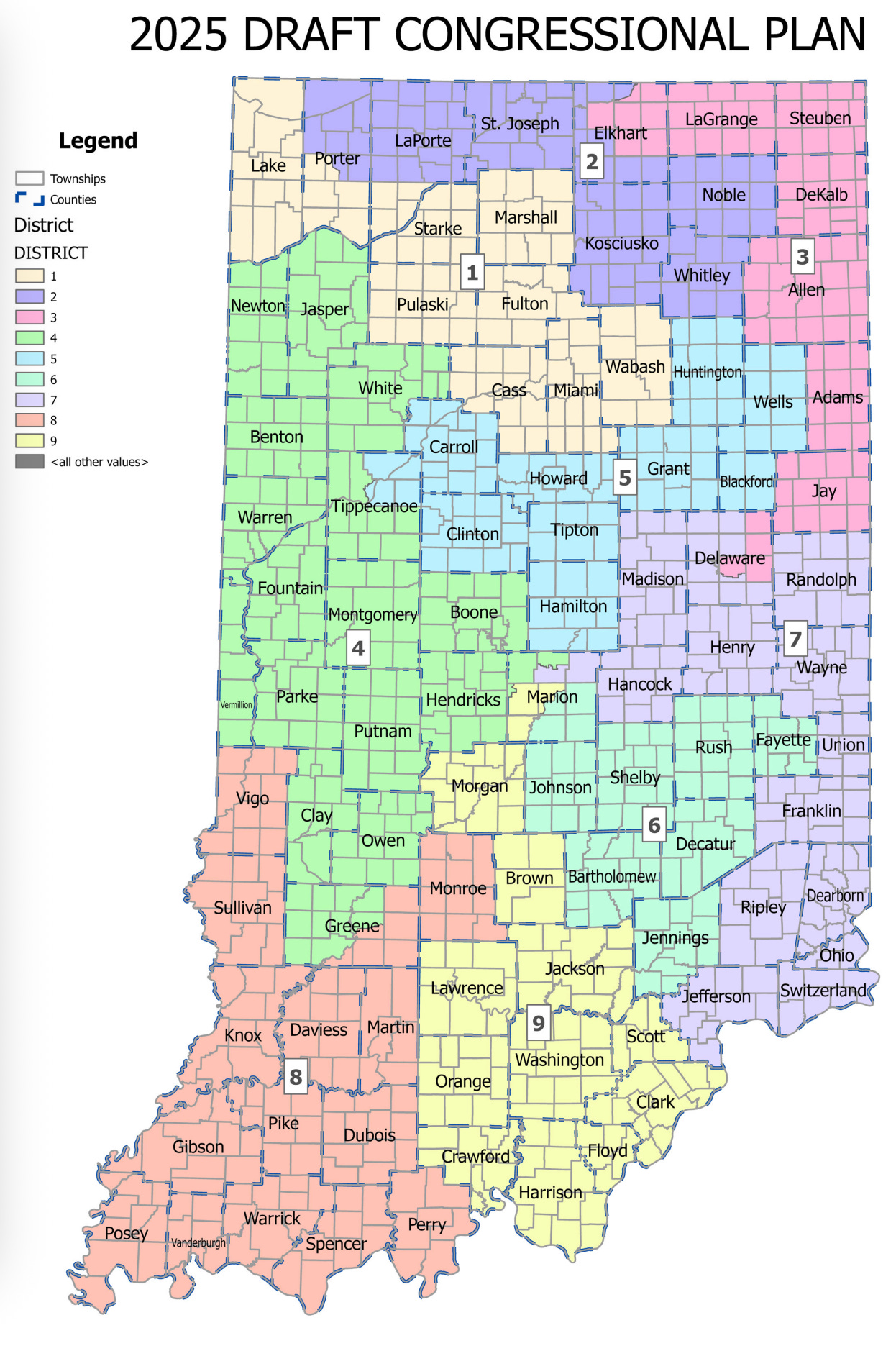
Maps designed and pushed by President Donald Trump to put Republicans in a better position to win all of Indiana’s nine congressional seats cleared the Indiana House on a 57-41 vote Friday afternoon.
From Tom Davies, reporting for the Indiana Capital Chronicle:
The House action sends the congressional redistricting issue to the state Senate, where its future is in real doubt. The chamber’s Republican leader has said for months that too few senators are in support for it to pass.
House members voted 57-41 in favor of the new maps crafted to produce a 9-0 Republican delegation by carving up the districts currently held by Democratic Reps. André Carson in Indianapolis and Frank Mrvan in the area along Lake Michigan near Chicago.
Twelve Republicans joined Democrats in opposing the bill.
Democratic lawmakers denounced the proposed redistricting as a racial gerrymander for dividing Carson’s 7th District — the state’s most urban and racially diverse — among four new districts. Those extend far into rural heavily Republican counties, with two of the proposed districts stretching to the Ohio River and another nearly reaching Lake Michigan.
Republican Rep. Ben Smaltz, author of the redistricting plan in House Bill 1032, maintains the new districts were drawn “purely for political performance” of GOP candidates.
Attention will now turn to the state Senate, which is scheduled to take up the proposed maps beginning Monday.
Senate President Pro Tem Rodric Bray has repeatedly declared too few senators are in support for redistricting to pass. But under political threats from Trump and Gov. Mike Braun, Bray announced two days before Thanksgiving that senators would make a Statehouse return to “make a final decision on any redistricting proposal sent from the House.”
For more coverage from the Indiana Capital Chronicle: “Indiana House approves redistricting bill, sending issue to state Senate.”
The local votes
Among state representatives with districts that include Tippecanoe County, Rep. Mark Genda, R-Frankfort, was among a dozen Republicans in the Indiana House who voted against the maps.
Genda signaled his opposition to mid-decade redistricting early in the process, saying he’d heard overwhelming criticism of the plan from his constituents. In October, after Gov. Mike Braun called for a special session, Genda said redistricting was “the No. 1 talking point” among his constituents. At the time, Genda told BiL: “At first, I was a ‘no.’ Now, I’m a ‘never.’”
The vote fell along party lines among the rest of the delegation:
Yes: Republicans Matt Commons, R-Williamsport, and Heath VanNatter, R-Kokomo.
No: Democrats Sheila Klinker, D-Lafayette, and Chris Campbell, D-West Lafayette.
Commons, whose district includes southern and western parts of Tippecanoe County, was an early advocate for redistricting and hadn’t wavered.
During a morning of speeches on the Indiana House floor, nearly all from Democrats, Campbell and Klinker joined in criticism. Klinker called the map “a disservice to the people of Indiana.”
Klinker held up news coverage in Lafayette earlier this week of a fake bomb threat that targeted a home that once belonged to state Sen. Ron Alting, a Lafayette Republican. The call prompted a response from the Tippecanoe County Bomb Squad to a home now owned by a local pastor and his family. The swatting attempt was among at least a dozen targeting state lawmakers in recent weeks – including one at the West Lafayette home of state Sen. Spencer Deery.
“I’m asking, is it worth it?” Klinker asked. “Is it worth it to have this happen to our good friends and colleagues that we’ve worked with for years? … I think as a group, we need to rethink this.”
After the vote, Campbell said Hoosier “deserve a legislature that doesn’t carve up their communities for political benefit.”
“Our communities won’t have a unified voice in Congress,” Campbell said. “These are families who share the same schools, the same main streets, the same concerns about jobs, health care and their kids’ future. Purdue University is the largest employer and biggest driver of economic development for West Lafayette. It’s split between two districts. How is that fair representation for our community?”
Heading to the Senate
The two Republican senators who represent parts of Tippecanoe County remain split on how they would vote on the House-drawn maps.
Sen. Ron Alting announced in November that he would back the redistricting push, calling it important to moving Trump’s agenda in Congress.
After Friday’s vote, Alting told BiL: “I remain troubled that these maps split apart long-standing communities in Tippecanoe County that share schools, employers and daily life. I will support advancing the bill when it comes to the Senate, but nothing I’ve seen suggests the votes exist to make it law.”
Sen. Spencer Deery has been outspoken against the concept of mid-decade redistricting in general and against the maps that went before the Indiana House specifically. This week, Deery picked apart the way the proposed maps cut through West Lafayette neighborhoods, saying, “If this map becomes law, you could work at Westminster Village and walk across the street to a home on the other side of North Salisbury and find yourself in a different congressional district. The same could be said if you worship in University Farms and live on the other side of Cumberland.
On the concept itself, Deery said: “The proposed map also offers a case study in how normalizing mid-cycle gerrymandering empowers mapmakers to eliminate primary challengers. I don’t have a public position on the District 4 Republican primary, but I would not be surprised to see more primary challengers at all levels pushed out by incumbent mapmakers rather than by the will of the people if we start drawing maps more than once a decade. That would be bad for voters of all political stripes, but given the power dynamics in our state, it would be especially harmful to conservative Republican challengers.”
How the maps split up Tippecanoe County
Locally, the proposed mid-decade redistricting maps splits Tippecanoe County into two districts, with often jagged lines cutting up Lafayette and West Lafayette in indecipherable ways – beyond the admission that it was done to divvy up voters to get to get Republicans from a 7-2 advantage in Indiana’s congressional delegation to 9-0.
The map would split Tippecanoe County between U.S. House District 4 – which currently covers the entire county and its neighboring counties and is represented by Republican Jim Baird – and House District 5, represented by Republican Victoria Spartz.
Among its features: splitting Lafayette in half, dividing up Purdue’s campus; leaving Lafayette, Tippecanoe and West Lafayette school districts with schools in different congressional districts; and splitting some neighborhoods.
Here’s more on that:

Other reads
Politico’s Adam Wren and Samuel Benson reported Friday that Turning Point USA and other super-PACs were lining up campaigns targeting Republicans who don’t fall in line with Trump on redistricting. (That was something Lt. Gov. Micah Beckwith said was coming in November, as he helped engineer a challenge of Deery by former Fountain County Clerk Paula Copenhaver, telling BiL: “Beckwith on new, redistricting-driven Deery-Copenhaver primary: ‘I’m on a mission now.”) Here’s Politico’s reporting Friday: “Trump-allied PACs target Indiana Republicans blocking redistricting push.”
Thank you for supporting Based in Lafayette, an independent, local reporting project. Free and full-ride subscription options are ready for you here.
Tips, story ideas? I’m at davebangert1@gmail.com.
Does Alting know he can vote against things he doesn’t like?
It has been written in previous years that the state wanted to split Tippecanoe County; so there is something else going on beyond splitting Indianapolis.into four different parts. One can only guess but could it have anything to do with gaining control of a bountiful water source Tippecanoe county has? What other reason or reasons could there be?
I am baffled by Alting's stand. He says it's not good for the county but he's going to vote yes anyway?
What kind of statement is that?