

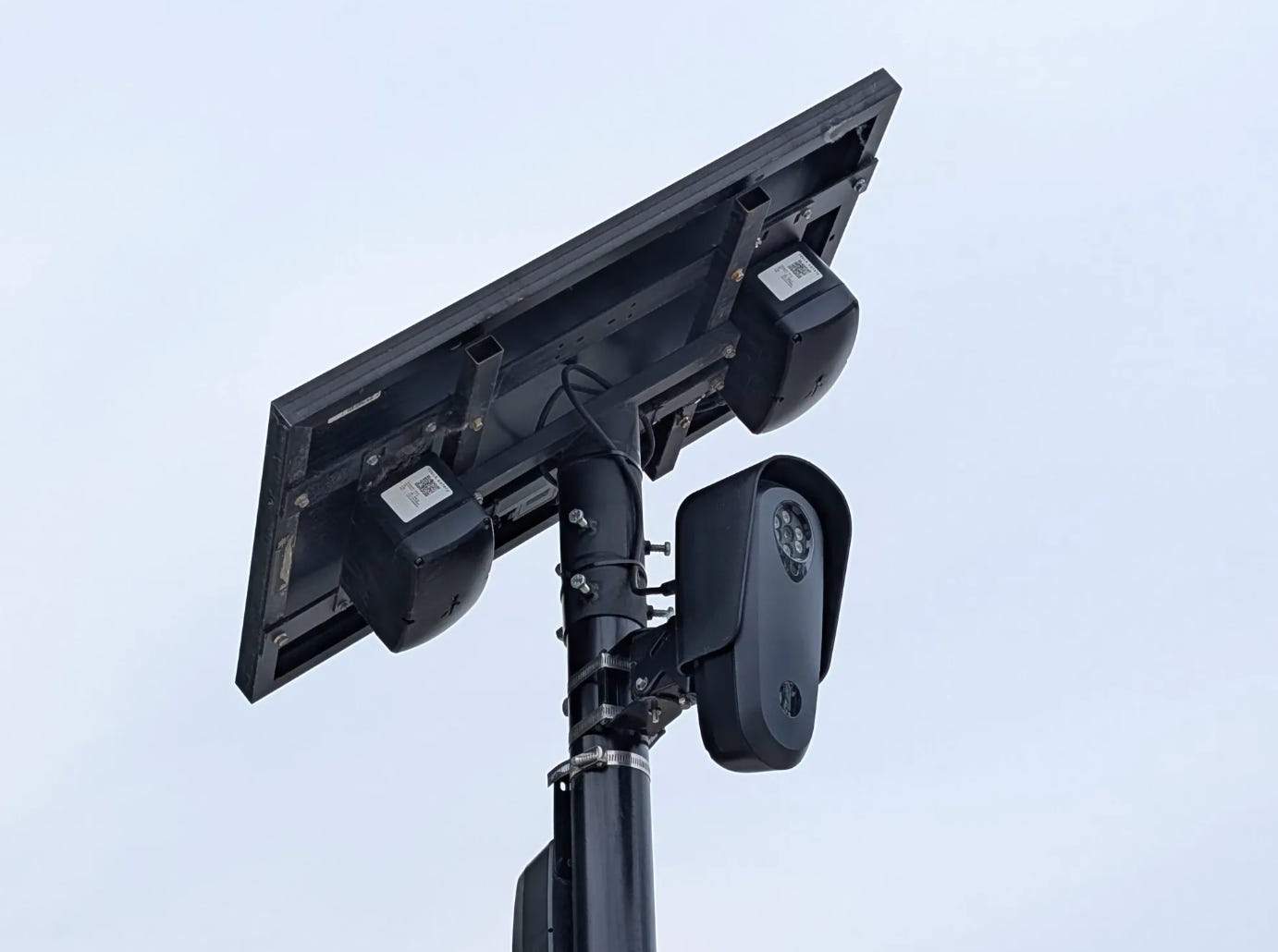
With protest growing amid calls for local police to ditch automated license plate readers over civil rights concerns about surveillance on Greater Lafayette roads and how mass AI-driven data collected and managed by a company supplying the cameras could be misused, Lafayette Mayor Tony Roswarski on Monday said the city stood by Flock Safety cameras first deployed in 2022.
“They’re one of the least invasive ways that we do to gather information,” Roswarski, who was with the Lafayette Police Department before being elected mayor in 2003, said in response to a round of pleas to the city council in recent months to end a contract with Georgia-based Flock Safety.
“I can assure you, the city of Lafayette and the Lafayette Police Department has no desire to be involved with mass surveillance in any way,” Roswarski told city council members. “We’re trying to do this to keep our community safe and make it a great place to live, work and raise your family.”
On the West Side, where the city council faced similar requests Monday to dump the city’s share of cameras in Flock’s nationwide network, Council President Larry Leverenz said the city’s police and information technology departments were reviewing the system in light of recent concerns.
West Lafayette Deputy Chief Dave VanVactor said this week that meetings were being arranged between police, city council members and the city’s IT department with Flock Safety to see whether assurances given when WLPD first installed the license-plate reading technology were still good or needed to be adjusted. VanVactor, who said the city’s four automated license-plate readers have played a big part in solving crimes in West Lafayette, said he hoped to be able to report back to the council in September.
“Some of the things that have been talked about on social media and other places, Flock has told us basically the opposite of what’s being put out there,” VanVactor said. “But this is worth revisiting because it has been several years since we’ve had a lot of communication on that end of things. But I’m hopeful that we get some good answers that we’re able to present to the public that will help ease some of the concern. … This will be a good opportunity for us to hold their feet to the fire, to give us honest answers.”
Flock’s array of cameras deployed in and around Lafayette, West Lafayette and Purdue have spurred “Deflock” campaigns and a new petition to get rid of them.
Among the concerns are skepticism that the tracking ability of the cameras will be limited to times when police are trying to solve crimes, instead offering easy access to abuse privacy and civil rights, including tracking people in certain parts of the community or those involved in constitutionally protected dissent. They said they worried that technology designed to capture make, model and plate information from passing cars too easily could be expanded into face recognition, voice recordings and more as technology and police desire grew.
Residents this week also said the city should be as wary as they are about whether data collected locally is truly under the cities’ control or whether, as the petition states, “accumulation of this data can be used for indefinite tracking, creating a climate of fear and oppression instead of one of safety and protection.”
“It seems like ‘1984,’” Quinnell Gutwein, a Lafayette resident, told the Lafayette City Council Monday, referencing the novel by George Orwell.
West Lafayette resident Erin Moon-Walker told the West Lafayette City Council the same night that she could take personal steps with her tech usage not to support companies she suspected were backed by those who might abuse personal data.
“But I can’t remove the Flock camera at the end of my street that records my family’s movements in a database, where information is supposed to be deleted by the company according to what reads like a ‘Trust Me, Bro’ clause in the contract, even in light of the resolution that was passed and through no fault of our police department,” Moon-Walker said.
