

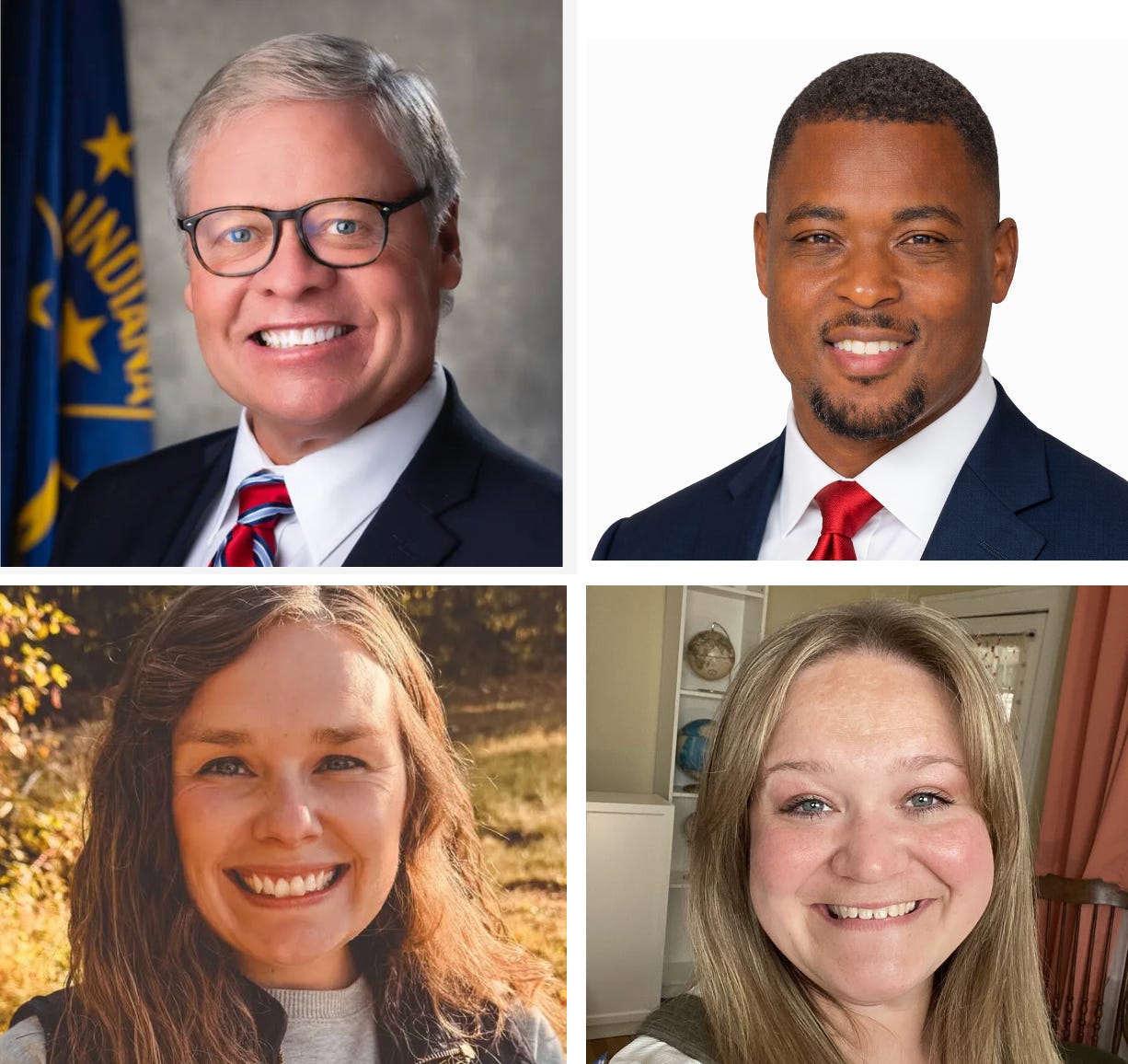
State Sen. Ron Alting faces a challenge from three candidates, including one in the Republican primary, in 2026 in Indiana Senate District 22.
Alting, first elected to the Senate seat in 1998, faces Republican Richard Bagsby, a construction business owner from Tippecanoe County, in the primary.
Natasha Baker, a teacher from Battle Ground, and Marlena Edmondson, a social worker from Lafayette, are vying for the Democratic nomination.
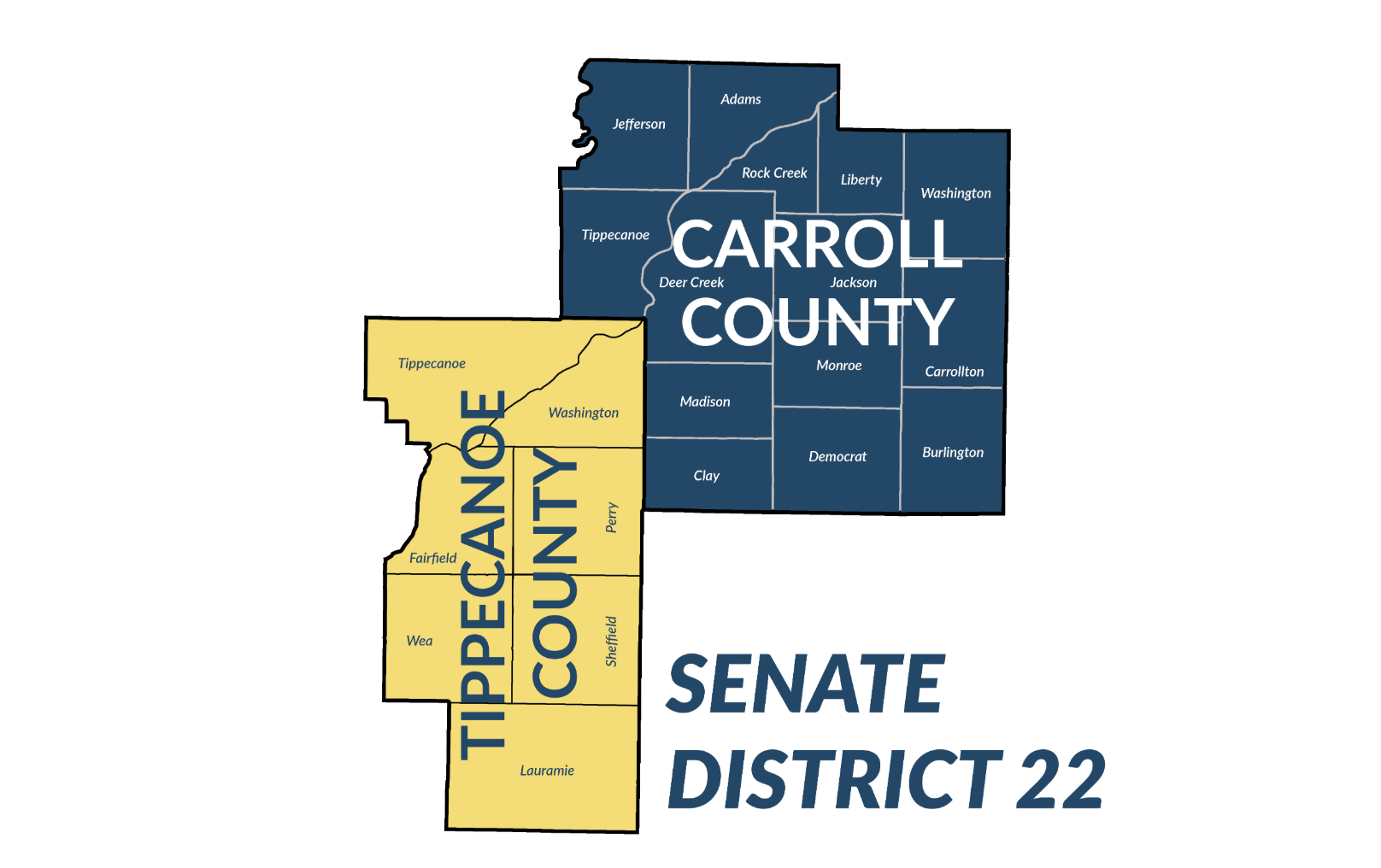
Indiana Senate District 22 includes Lafayette, an eastern portion of Tippecanoe County and all of Carroll County.
Here, candidates answer questions about their approach.
For more: Find bios of each candidate, along with information about where and when to vote, at the end of this article. Watch in the coming days for more candidate Q&As in other races on Tippecanoe County primary ballots.
Why do you want this job? Why are you running now for this position?
Republicans
Ron Alting: I enjoy working for my constituents as a public servant. It is truly a civic honor, not just a job, but a responsibility to serve the community and state where I was born and raised. As a conservative, I believe in giving back and making sure government works for the people, not the other way around.
Richard Bagsby: I’m running because District 22 deserves a senator who will fight for the people instead of protecting the political class. Too many Hoosiers feel ignored while taxes go up, energy bills rise, farmland is threatened, and families struggle to afford basic necessities. I’m running now because voters are tired of career politicians who have been in office for decades and still cannot explain why life keeps getting harder for the people they represent. I’m running to challenge the status quo, bring accountability back to Indianapolis, and fight for working families.
Democrats
Natasha Baker: I want this job because our communities deserve representation that is in touch with the current needs of Indiana’s families and working people. For far too long, our representation has primarily been composed of representatives pulled from a very limited segment of population. This homogenous group of legislators have been writing legislation for people that are living very different lives than them. They frequently put business and personal enrichment over constituents. I am running now because I needed someone to root for and couldn’t find that person in District 22, so I decided to become that person. I am a mother of a young family and a teacher, a demographic that is not well represented amongst our current legislators.
Marlena Edmondson: Advocating has been a major part of who I am since childhood. Growing up in poverty, I had limited opportunities, and the supportive programs like Medicaid, WIC, and SNAP weren’t enough. My need to stand up for inequality blossomed into a career as a social worker because I knew I could directly help individuals, children, families, and communities. I knew one day I would advocate for policy change at a higher level. After 15 years of advocating in the child welfare, juvenile justice systems, and public education, I fine-tuned my skills and confidence to take them to the next level and widen my circle and depth of advocacy. Since studying political science and social work, I knew I wanted to someday earn the trust of Hoosiers and become a megaphone for their voice at the statehouse.
Name two of your top priorities for the position. And how will you handle them?
Republicans
Ron Alting: One priority is managing growth responsibly. Our district is growing quickly, and we need to ensure infrastructure, housing, and public services keep pace. I will continue working with local leaders and state agencies to support smart development while protecting our communities. Second is affordability, especially property taxes and cost of living. I will continue fighting for policies that provide real relief to homeowners in Tippecanoe and Carroll Counties while maintaining strong funding for schools and public safety.
Richard Bagsby: My first priority is property tax relief. Hoosiers are being taxed out of their homes while local government spending keeps growing. I will push for stronger protections for homeowners, especially seniors and working families, while demanding more transparency and restraint from local governments. My second priority is lowering the cost of living. Families are being crushed by utility bills, grocery prices, insurance costs, and inflation. I will oppose policies that let monopoly utilities and politically connected interests pass more costs onto consumers. Government should be helping Hoosiers keep more of what they earn, not making it harder to survive.
Democrats
Natasha Baker: For this position, I want to fully fund public education so our communities can continue to thrive and preserve the separation of church and state to protect the freedom of all Hoosiers, regardless of religion. I will use the First Amendment and Establishment Clause when voting or drafting legislation to prevent the further blurring of church and state. As far as public schools, it is imperative that we look at where taxes are being poured into instead of education, including data center tax breaks, Gov. Braun’s Midstates Corridor projected to cost the state upwards of $3 billion, and politician raises.
Marlena Edmondson: Affordability is my top priority, and it blends with several of my other priority issues. More and more Hoosiers are struggling with everyday living expenses like groceries, housing, utilities, and childcare. When individuals and families struggle with financial stability, we see the impact on our children and communities. Without protections for renters, higher expectations for landlords, food assistance programs, utility regulation, and financial supports, individuals and families struggle, crime rates increase, mental health declines, and community resources are stretched thin. If elected, I would push for regulations to limit price gouging, protections for renters, enforce policies to hold landlords accountable, provide access to affordable housing and healthcare, and access to mental health services, as well as an increase in the minimum wage. The impact of our affordability crisis is evident in our public schools. As a school social worker for 13 years, because of the struggles many families are facing, I’ve seen firsthand the impact it has on our students and families and how it shows up in our classrooms. Teachers and staff are struggling to meet the needs of students with limited resources, but growing concerns. I would advocate for incentive pay for teachers and staff in positions that are difficult to fill. For example, in rural communities where resources are limited and in schools where needs are high for the number of families living in poverty. I would push for an increase in school social workers to address the growing needs of our students and raise their status to be equal to that of other school professional positions, such as school counselors, teachers, nurses, and school psychologists. The School Social Work Association of America (SSWAA) recommends one social worker for every 250 general education students. The ratio lowers to one social worker for every 50 students when providing services to students with intensive needs. In Indiana, our ratio of school social workers to students is 1: 1,829. To say our shortage of school social workers is urgent is an understatement, especially when our youth suicide rates are higher than the national average, and there’s a critical shortage of mental health professionals in rural communities.
What’s the biggest challenge facing your district in the next four years? And how do you propose to address that?
Republicans
Ron Alting: The biggest challenge is balancing growth with maintaining our quality of life. With expansion tied to Purdue University and new development, we must ensure housing remains attainable, infrastructure keeps up, and neighborhoods stay strong. I will focus on coordinated planning, infrastructure investment, and policies that support responsible, locally guided growth across both counties.
Richard Bagsby: The biggest challenge is affordability. Families are falling behind because government is making life more expensive instead of more affordable. Property taxes, housing costs, child care costs, health care costs, and utility bills are all going up at the same time. I believe the answer is simple: stop making government bigger and start making life easier for the people paying the bills. I will focus on tax relief, spending restraint, lower energy costs, stronger wages, and policies that put local families first.
Democrats
Natasha Baker: In the next four years, I believe that exploding growth will be the main challenge facing District 22. Economic development, coupled with the population growth that is expected to come with it, will present challenges such as affordable housing, healthcare, education, and land usage. Industrialization in terms of warehouses, data centers, in addition to growing concerns about the future of utilities like solar, will become the forefront of concern for many of the constituents in District 22 across the political spectrum. To address this, it is important for legislators and community members to work together to create a plan that is harmonious with the current plan for District 22, the desires of the community, and fits the county and state plans for economic development. There should be oversight, open bidding, and no non-disclosure agreements signed in order to make sure constituents have a say in the direction of their own community.
Marlena Edmondson: District 22’s biggest struggle is going to be around financial stability due to changes in property tax reform and rising costs. The implications of Senate Bill 1 regarding property taxes have been presented, and our local governments are going to struggle with the loss of revenue, which will have a larger impact on smaller communities. To address this, we need to reverse changes made by bad legislation. Businesses and corporations shouldn’t benefit while personal and family stability is at risk.
How would you rate the property tax reform measures of Senate Bill 1, signed into law in 2025? What, if any, adjustments would you advocate in upcoming General Assembly sessions?
Republicans
Ron Alting: I voted no on Senate Bill 1 because research showed it would have limited impact on the average homeowner while shifting more burden onto local communities and essential services. I strongly support property tax relief, but it must be done in a way that truly helps homeowners, especially seniors and middle-income families, while ensuring local governments can continue to fund police, fire, and schools. More work is needed, and I will continue pushing for practical, responsible solutions.
Richard Bagsby: Senate Bill 1 was not enough. It gave lawmakers something to campaign on, but for many homeowners it did not provide the level of relief they actually need. People are still watching their tax bills climb while government keeps finding new ways to spend money. I would push for stronger tax caps, greater relief for owner-occupied homes, stronger protections for seniors on fixed incomes, and more accountability for local governments. If local governments want to spend more money, they should have to justify it directly to the taxpayers.
Democrats
Natasha Baker: The harmful effects of SB 1 have only just begun to be felt across Indiana and in District 22. State employees will not receive raises, funding to local emergency services have been cut, millions have been pulled out of our local school districts, culminating in local municipalities to raise local taxes or cut essential services. Regressive in nature, SB 1 raises property taxes on low-income families, while others will see a short term decrease to their property taxes of a few hundred dollars. Lowering taxes without a tangible plan to replace this income is irresponsible. This will lower the quality of life of Hoosiers across the state and because of this I rate this property tax bill a 1/10. To address this, new income sources for Indiana need to be explored and the tax code needs to be replaced with a progressive tax system that ensures corporations, data centers, and large conglomerates pay into the system at the same rate as the average Hoosier, allowing property tax relief to come to veterans and seniors.
Marlena Edmondson: Senate Bill 1 has many issues, and like many bills, it was deceiving in how it was presented to Hoosiers. I will push for more protections for seniors to limit their property tax burden. I will advocate for adjusting the business personal property exemption; $2 million is too high and is a benefit to larger businesses. We can help small businesses without giving more relief to bigger businesses that don’t need it. I am willing to collaborate with other legislators to come up with creative solutions regarding the valuation floor removal and the homestead deduction. We could focus on other sources of revenue such as legalizing marijuana, increasing corporate tax rates, and limiting tax abatements to big corporations. We need to make changes, but we can do better than Senate Bill 1.
What’s the best thing the Indiana General Assembly can do to improve access to quality health care? And how would you propose getting that done?
Republicans
Ron Alting: Expanding access to healthcare, especially primary care and mental health, is critical. In our region, that includes strengthening partnerships with providers like IU Health and Franciscan Health. I will continue to support policies that bring more providers into underserved areas, expand telehealth, and reduce barriers so residents in Tippecanoe and Carroll counties can get the care they need.
Richard Bagsby: Indiana needs more doctors, nurses, and providers, especially in rural communities. Too many Hoosiers are waiting too long for care or driving too far to get it. We should make it easier to recruit and retain medical professionals while removing unnecessary red tape that limits access to care. At the same time, we need more transparency in health care pricing. People should know what they are paying for before they receive care. Competition lowers costs, and patients deserve more choices, not fewer.
Democrats
Natasha Baker: Vulnerable populations in our state are going without healthcare. By cutting Medicaid and Medicare services across the state, our rural hospitals, especially labor and delivery units, are shuttering. Tax dollars need to be used on services for people that keep our rural hospitals open and accessible for everyone. Cutting Medicaid, which in turn closes hospitals, hurts local economies and rural Indiana, like District 22, at higher rates than suburban or urban areas. Indiana can implement more pipeline programs that help train and recruit members from the community as healthcare professionals and make rural communities desirable by investing in child care, public schools, and local businesses to make rural Indiana desirable locations to live and work.
Marlena Edmondson: Indiana needs to do everything it can to regulate the healthcare system. Without regulation, we are seeing patients being exploited for profits and access to healthcare being pulled from vulnerable populations like rural communities. If elected, I will join legislators in regulating healthcare in Indiana by supporting bills that will increase oversight of hospitals and insurers, increase competition, prevent monopolies, increase transparency in pricing, reform healthcare administration, and strengthen consumer rights and processes for appealing denials and filing complaints.
What would be the best thing, if anything, the state could do to solve what has been reported as a shortage of available, affordable child care in Indiana?
Republicans
Ron Alting: Childcare is a major issue for working families in Tippecanoe and Carroll counties. It is important to work with non-profits and the private sector to expand access, including employer-supported childcare and community partnerships like the YMCA. The state can help by supporting providers through workforce development, reducing unnecessary regulatory burdens, and offering targeted financial support to make childcare more accessible and affordable.
Richard Bagsby: Indiana needs to make it easier to open and operate safe, affordable child care facilities. Too many parents are struggling because the cost of child care is almost as much as a second mortgage. I would support cutting unnecessary regulations that drive up costs without improving safety, while also encouraging more small providers, churches, and community organizations to offer child care solutions. If we want stronger families and a stronger workforce, we have to make child care more available and more affordable.
Democrats
Natasha Baker: Indiana needs to open back up its child care voucher system and make it accessible to more parents. I support universal pre-K because it has shown great value for student development and outcomes, as well as economic benefits. Money spent on childcare comes back into the community in the form of workers and labor, allowing businesses to thrive. Indiana can introduce tax incentives for workplaces and employers that offer on-site childcare or credits to their employees. Indiana can also implement grant programs that build new centers or expand current centers to address the childcare crisis facing much of Indiana.
Marlena Edmondson: We have to balance lowering childcare costs without cutting the quality of services. The costs of infant care in Indiana are higher than the national average. We cannot cut safety measures and required certifications that would put us at risk of higher infant mortality rates that are already above the national average. Indiana has lost over 300 childcare centers because of the cut to vouchers through the Child Care Development Fund. Lower-income families relied on these vouchers for childcare assistance, the cuts then forced them to leave the workforce. I would advocate that we open vouchers again so we can get as many children safe and appropriate childcare, and so their parents can return to work and provide for their families.
Should the General Assembly do anything that makes it easier or more difficult, either one, for developers of data centers to find suitable places to build and operate in Indiana?
Republicans
Ron Alting: Data centers can bring investment, but they also require significant infrastructure and energy. Any development must be handled responsibly, with local communities having a strong voice in the decision-making process. In our district, local control matters. I would support policies that encourage responsible development while ensuring our communities are protected and prepared.
Richard Bagsby: Indiana should not hand over farmland, water resources, and power infrastructure to massive data center projects without serious scrutiny. I support economic growth, but not at the expense of local communities and ratepayers. If data centers want to come to Indiana, they should prove they will not overwhelm our electric grid, drive up utility bills, consume excessive water, or destroy prime farmland. Local communities should have a real say before these projects move forward.
Democrats
Natasha Baker: Indiana needs to make it more difficult for data centers to take up residence on our farmland. The push for data centers and their subsequent construction, have outpaced legislation and oversight. Tax moratoriums and the usage of Indiana’s precious natural resources when we already rank last in terms of pollution and air quality should not be offered to developers. The current research that is out there shows that data centers lower property values, harm the environment, irreversibly convert farmland to industrial land, and offer no significant labor, especially union labor, after the initial buildout. Indiana can leverage taxation to control the growth. Taxing these data centers will cause them to contribute to our communities while naturally slowing their growth.
Marlena Edmondson: It is the obligation of legislators to preserve our community integrity and protect our land resources. We must maintain and continue to define environmental standards, while also supporting responsible economic growth and transparent development deals. Indiana is a hotspot for data center development, due to our tax incentives, long-term abatements, & the limited state‑level regulations; often at the expense of the community as we have seen in other counties. I do think it is imperative as legislators to work towards requiring evaluation of environmental and economic impacts, transparency in development deals, strengthen water protections, and advocate for legislation that ensures ratepayers aren’t subsidizing private development. This could be viewed as more difficult, but more in line with our role representing our community and what is best for them.
How do you rate the K-12 education system in Indiana? What’s one thing you’d advocate to make it better, and how would you get that done?
Republicans
Ron Alting: We have strong schools and dedicated teachers, but we need to do more to support and retain educators. I will continue working to improve teacher pay and reduce administrative burdens so teachers can focus on students. I have worked hard to help Indiana make progress, including improving reading scores and reaching record graduation rates, but we still have more work to do.
Richard Bagsby: Indiana’s schools have strengths, but too many schools have drifted away from the basics. Parents want schools focused on reading, math, science, discipline, and career readiness, not politics and social agendas. I would push for stronger parental rights, greater transparency in the classroom, and a stronger focus on academic fundamentals. Schools should answer to parents, not bureaucrats.
Democrats
Natasha Baker: I am a product of Indiana’s public education system and I have worked in Indiana’s education system since graduating from Purdue in 2013. I have spent all of my time as a teacher at Lafayette Jeff and now in Carroll County. My oldest child is also a part of Indiana’s education system. With the cuts to K-12 education over the next three years set to take effect and money being pulled from public schools that educate 90% of our students going to private and voucher schools, I rate our current system a 5/10. I would advocate for funding that keeps up with inflation at the minimum and implement programs that retain and attract quality teachers. I would also advocate for an income cap to Indiana’s school voucher program.
Marlena Edmondson: It is difficult to assess where Indiana’s education system is at knowing the changes to come soon due to Senate Bill 1. The changes in our property taxes will greatly impact the quality of the services provided by local government, especially public education. We need to increase our resources and funding to public schools – not cut them. And ensure the funding returns to schools following state requirements for reporting and transparency, something that charter and private schools are not required to do. This funding would also allow salary incentives to teaching positions difficult to fill in areas that need it most, such as rural communities and schools with high rates of poverty. I will push to address these new policies and propose legislation to bring tax dollars back to our public schools, and improve our education system in Indiana.
What, if any, changes would you make to loosen or tighten Indiana’s laws on hemp-based products?
Republicans
Ron Alting: This is an area where stronger oversight is needed. There are legitimate health concerns, and we need clearer, consistent, and transparent regulations. I support reasonable safeguards like age restrictions, proper labeling, and safety standards so consumers are protected and businesses in Tippecanoe and Carroll counties have clear guidelines to follow.
Richard Bagsby: I would tighten the laws on intoxicating hemp-based products, especially products that can be marketed to children or sold without proper safeguards. Too many of these products are packaged in ways that appeal to minors, and too many loopholes exist in the current law. Adults should have clarity about what is legal, but the state has a responsibility to make sure intoxicating products are not ending up in the hands of children.
Democrats
Natasha Baker: Hemp is a large Indiana industry and to tighten laws related to hemp would put a significant strain on farmers and small businesses across the state. By tightening laws, we would also lose out on tax dollars and consumers would begin funding another state’s hemp industry. Hemp has the potential to be a great income source for Indiana, farmers, and small businesses. A bipartisan group can come together to create thoughtful regulation that makes this industry great once again.
Marlena Edmondson: My main concern about hemp-based products would be marketing that is enticing to minors. Many products mimic candy, and my concern is for the products containing “intoxicating cannabinoids” being misused or accidentally ingested. I would present and support legislation that would require stricter marketing guidelines such as laws already in place in California, Colorado, Illinois, New York, Oregon, and Washington. Similar bills failed to pass in the Indiana General Assembly this year because lawmakers couldn’t agree on balancing safety concerns with the wants of the industry leaders.
If elected, you’ll likely have to navigate a Republican supermajority in both chambers of the General Assembly when representing your district. How will you do that, and what makes your prospects for success better than those of your opponent?
Republicans
Ron Alting: In this past session, I was proud to have 11 bills reach the governor’s desk and be signed into law. That comes from experience, hard work, and strong working relationships. Getting results in the legislature requires persistence and the ability to work effectively with colleagues, state agencies, and local leaders. I will continue focusing on delivering real results for our district, not just making statements, but solving problems.
Richard Bagsby: I will navigate it by doing what career politicians often refuse to do: tell the truth, fight hard, and refuse to back down. You build coalitions issue by issue, but you also have to be willing to challenge leadership when leadership is wrong. My advantage is that I will not owe the political establishment anything. I am not running to preserve the system. I am running to push it to do better. Voters are tired of politicians who have been in office for decades and still cannot explain why so many problems remain unsolved.
Democrats
Natasha Baker: I come from an extremely conservative family and those relationships are something that I have fostered and navigated my entire teenage and adult life. I have learned how to share my progressive views in a way that is grounded in commonality and respect, while also working to understand these different viewpoints. My family and I share many of the same values – freedom, patriotism, success, hard work, and the American Dream. I understand that sometimes it takes a unique approach when discussing those events within a Conservative lens when coupled with the context of feelings, ideologies, and current events.
Marlena Edmondson: As a social worker, I have the skill set to have difficult conversations; skills that are needed in moments of tension and division. These skills help navigate the interpersonal dynamics that exist between groups with seemingly competing interests, such as Democrats and Republicans. I can work to reduce polarization by moving discussions away from rigid positions and toward more productive engagement. Disagreement is expected, and some people will not be open to connection or new perspectives. I’ve worked with resistance throughout my career, and I know how to stay steady in those moments. I will continue to listen, advocate, and encourage critical, solution-focused thinking. My background – more than 15 years of working with complex situations, diverse communities, and challenging interpersonal dynamics – sets me apart from my opponents.
Name two specific things that separate you from your opponent and why those matter.
Republicans
Ron Alting: First, I bring experience and a strong focus on local issues that matter most to Tippecanoe and Carroll counties, including growth, infrastructure, and affordability. I began my service on the Lafayette City Council At Large and as Council President, where I gained firsthand experience working with local government and community leaders. Second, I have a proven record of delivering results. I understand how to work effectively with local officials, state agencies, and fellow legislators to get things done for our communities. That experience matters when it comes to representing our district and ensuring it gets the attention it deserves.
Richard Bagsby: First, I am willing to challenge the status quo. My opponent has been part of the system for decades. I am offering a different approach that is more aggressive on tax relief, affordability, parental rights, and accountability. Second, I am closer to the everyday concerns of working families. I understand what it means to worry about taxes, utility bills, business costs, and making ends meet because I have lived it. That matters because District 22 deserves a senator who understands the pressures people are facing, not someone who has been insulated from them for years.
Democrats
Natasha Baker: I am a wife, mother, and teacher. I have worked to balance my work life, family life, a small business, and my campaign. My diligence, drive, and work ethic are the greatest strength I can bring to any position or role that I have in my life. I am not the best public speaker, or the best at working a room, but when I commit, I fully commit. The constituents of District 22 can expect that same commitment to their rights and freedoms. The citizens of Carroll and Tippecanoe counties do not need a polished politician, they need someone that is going to show up for their interests and is raising a family in the same community they are. I am a listener that truly wants to see her community succeed. District 22 deserves a representative with integrity and one that votes according to the needs of the constituents every time.
Secondly, I have deep connections to all parts of my district. I have worked as a teacher in Carroll County for the last 12 years, live in Battle Ground, and grew up in Lafayette and West Lafayette. I offer a perspective that is in tune with many constituents across the district, even those that may not identify with me politically. I understand how the needs of rural District 22 differ and are the same as those in the more urban areas – because I am a member and have deep roots across the district.
Marlena Edmondson: The first thing that sets me apart from my opponent is my proven history of advocacy in our community throughout my life, and my personal connections to the communities our district covers. My roots with family members spread from Stockwell, Lafayette, Dayton, Battle Ground, and even Delphi. Since I was a teenager, I’ve been connected with the organizations in my community that supported me and my family for generations. As a first-generation student, I went to college with the intention to gain skills & knowledge to then come back and support the community that did so much for us. That’s exactly what I did. In helping individuals and families in need I’ve strengthened personal and professional connections with community agencies and continue to give back to those same resources and supports. Secondly, my career has been another testament to my advocacy work in helping others and strengthening our community. For over 15 years I have worked with individuals and families in Tippecanoe, Carroll, Clinton, White, Newton, and Fountain, which is a diverse makeup of urban, small-town, and rural communities. In my profession as a social worker, my values and beliefs naturally align with the high ethical standards and core values of the social work profession, which are service, social justice, dignity and worth of each person, importance of human relationships, integrity, and competence. These all values I will be bringing with me to the statehouse. These two specific things I’ve laid out do blend in many ways, but are both unique strengths I believe are what it takes to be a successful, community-focused public servant, and what sets me apart from all of my opponents.
Bios
Ron Alting
Party: Republican
Age: 70
Occupation: Small Business Owner
Educational background: Bachelor’s degree from Purdue University
Past elected positions: Lafayette City Councilman at Large
Community boards or other community leadership and service: Community Cancer Network and Art Museum of Greater Lafayette
Immediate Family: Daughter, Ashely; son, Ronnie Jr.
Your campaign site online: Social Media sites: Facebook: Senator Ron Alting. Twitter: @RonAlting
Richard Bagsby
Party: Republican
Age: 43
Occupation: Realtor and Construction Project Manager
Educational background: Associates of Applied Science Degree
Past elected positions, if any: Two term Indiana Delegate
Community boards or other community leadership and service: Licensed Minister and Youth Counselor
Immediate family: Sara Bagsby (Wife)
Your campaign site online: www.richardbagsbyforindiana.com
Natasha Baker
Party: Democratic Party
Age: 33
Occupation: Family and Consumer Sciences Teacher
Educational background: I graduated from Harrison High School in 2010, from Purdue in 2013 with a Bachelor’s in Family and Consumer Sciences and a minor in Child Development and Family Studies, and then in 2022 with a Master’s degree from Purdue University Global in Human Services.
Past elected positions, if any: None
Community boards or other community leadership and service:
Immediate family: I live with my husband Corey, my 7-year-old Fisher, my 4-year-old Maren, and my two dogs, Brownie and Sammy.
Your campaign site online: electnatashabaker.org and www.facebook.com/profile.php?id=61581908942480
Marlena Edmondson
Party: Democrat
Age: 38
Occupation: Social Worker
Educational background: William Henry Harrison High School, 2006; University of Indianapolis, Bachelor’s Degree in Political Science and Social Work, 2010; Indiana University, Master’s Degree in Social Work, 2011
Past elected positions, if any: none
Community boards or other community leadership and service: I have been part of Lafayette Urban Ministry since 2005. After three years as a summer camp camper in the 1990s, I returned as a volunteer camp counselor for 13 years. I was offered the position of Camp Director in 2018. This summer will be my ninth camp as the Camp Director and celebrating my 25th LUM Camp combining all of my experience. I have been a social worker in the community for 15 years. Throughout the years I have been invited to join several committees and specialized teams focused on safety and mental health, such as the MME School Safety Committee, Proactive Behavior Team, Prevention Youth Suicide Initiative Team, and SHAPE Team (school mental health assessment). I was a member of Lafayette Roller Derby, a local nonprofit, for 10 years. While working with the team, I was voted into the positions of Skater Relations Chair and President. I was the Head Referee for several seasons. I have the following certifications and professional memberships: Therapeutic Crisis Intervention Certification; Level 1 Trauma-Informed Certification from the Attachment & Trauma Network; The School Social Work Association of America, Serving on the Advocacy & Legislative Action Committee; The Indiana School Social Work Association, Serving on the Legislative Committee; Attachment & Trauma Network
Immediate family: Mother, Marie Edmondson; father: Charles Moore; siblings: Zach Welch and Aly Edmondson. Pets: cat, Charlie
Your campaign site online: www.MarlenaEdmondson.com
ABOUT THE MAY 5 PRIMARY
Early voting ahead of the May 5 primary election runs April 7 to May 4 with contested races on Tippecanoe County ballots for U.S. House, several Indiana General Assembly seats, Tippecanoe County commissioner and Tippecanoe County Council seats, township position and state convention delegates. Voters may choose a Republican or Democratic ballot, but not both, when checking in at the voting site.
Voter registration/ballots
To check your voter registration and to see candidates who will be on your R or D ballot, go to the Secretary of State’s portal at www.indianavoters.com.
Early voting sites
In Tippecanoe County, registered voters may cast their ballot at any vote center.
April 7 to May 4: Tippecanoe County Office Building, 20 N. Third St. in Lafayette. Weekday hours: 8 a.m.-4:30 p.m. April 7-10, April 13-17, April 20-24, April 27-May 1. Other hours: 9 a.m.-4 p.m. April 25 and May 2; and 8 a.m.-noon May 4.
April 18: McAllister Recreation Center, 2351 N. 20th St., Lafayette. Hours: 9 a.m.-1 p.m.
April 21: Córdova Recreation Center, 355 N. Martin Jischke Drive, West Lafayette. Hours: 10 a.m.-4 p.m.
April 23: First United Methodist Church, 1700 Mitch Daniels Blvd., West Lafayette. Hours: Noon-5 p.m.
April 25: West Point Fire Station, 4949 Indiana 25 S., West Point; Otterbein United Methodist Church, 405 Oxford St., Otterbein; and Clarks Hill Christian Church, 9510 Pearl St., Clarks Hill. Hours: 9 a.m.-1 p.m.
April 28-May 1: Tippecanoe County Fairgrounds, 1406 Teal Road, Lafayette; Wea Ridge Baptist Church, 1051 E. County Road 430 South, Lafayette; Eastside Assembly of God, 6121 E. County Road 50 South, Lafayette; and John Dennis Wellness Center, 1101 Kalberer Road, West Lafayette. Hours: Noon- 6 p.m.
May 2: Tippecanoe County Fairgrounds, 1406 Teal Road, Lafayette; Wea Ridge Baptist Church, 1051 E. County Road 430 South, Lafayette; Eastside Assembly of God, 6121 E. County Road 50 South, Lafayette; and John Dennis Wellness Center, 1101 Kalberer Road, West Lafayette. Hours: 9 a.m.-3 p.m.
Election Day vote centers
Voting on Tuesday, May 5, will be 6 a.m.-6 p.m. Registered voters in Tippecanoe County may choose any of these sites.
Lafayette
Tippecanoe County Fairgrounds, 1406 Teal Road
Lafayette Community Church of the Nazarene, 3801 Union St
The Grove Covenant Church, 3600 S. Ninth St.
Tippecanoe County Historical Association History Center, 522 Columbia St.
Wea Ridge Baptist Church, 1051 E. County Road 430 South
Eastside Assembly of God, 6121 E. County Road 50 South
Northend Community Center, 2000 Elmwood Ave.
West Lafayette
Faith West Community Center, 1920 Northwestern Ave.
Córdova Recreation Center, 355 N. Martin Jischke Drive
Connection Point Church, 2541 Cumberland Ave.
John Dennis Wellness Center, 1101 Kalberer Road
Outside Lafayette/West Lafayette
Shadeland Town Hall, 2485 Indiana 25 West, Shadeland
Tippecanoe Township Volunteer Fire Station No. 2, 448 W. County Road 650 North, West Lafayette
Dayton Gathering Point Church, 7201 Wesleyan Drive, Dayton
Battle Ground Fire Station, 112 North St., Battle Ground
On the ballot
Here are candidates who will be on Tippecanoe County ballots in the May 5 primary. (* = incumbent)
Tippecanoe County
Commissioner, District 1: Julie Roush and James Waters, R; Andrea Burniske, Travis Dowell, Justin Kendall and AR Lane, D
County Council, District 1: Ben Murray*, D; Trent Richter, R
County Council, District 2: Jody Hamilton* and Jonathan Chapin, R
County Council, District 3: Lynn Beck, R
County Council, District 4: Lisa Dullum*, D
County Clerk: Abby Myers and Carrie Sanders, R; Karan Benner, D
Assessor: Anthony Hustedt-Mai, R; Kaitlyn Butler, D
Auditor: Jennifer Weston*, R; Eric Grossman, D
Recorder: Kristy Martin*, R; Monica Casanova, D
Prosecutor: Jason Biss, R
Judge, Superior Court 1: Kevin McDaniel*, R
Judge, Superior Court 2: Sarah Wyatt, R
Judge, Superior Court 4: Matt Sandy*, R
Judge, Superior Court 5: Kristen McVey*, R
Judge, Superior Court 7: Dan Moore*, R
Indiana General Assembly
House District 13: Matt Commons*, R; Brenna Geswein and Ed Moyer Jr., D
House District 26: Chris Campbell*, D; Magdalaine Davis, R
House District 27: Sheila Klinker*, D; Tracy Brown and Oscar Alvarez, R
House District 38: Heath VanNatter* and Mark Hufford, R; and Nate Stout, D
House District 41: Mark Genda*, R; Jackson Hayes, D
Senate District 22: Ron Alting* and Richard Bagsby, R; Natasha Baker and Marlena Edmondson, D
Senate District 23: Spencer Deery* and Paula Copenhaver, R; David Sanders, D
Congress
U.S. House, District 4: Jim Baird*, Craig Haggard and John Piper, R; Drew Cox, Roger Day, Darin Griesey, Thomas Hall Jr., Robert Lovely, Joe Mackey, Jayden McCash, Paul McPherson and John Whetstone, D.
For a look at all candidates on Tippecanoe County primary ballots, including those for township trustee, township boards and state delegates, here are links to Democratic candidates and Republican candidates.
Thank you for supporting Based in Lafayette, an independent, local reporting project. Free and full-ride subscription options are ready for you here.
Tips, story ideas? I’m at davebangert1@gmail.com.