

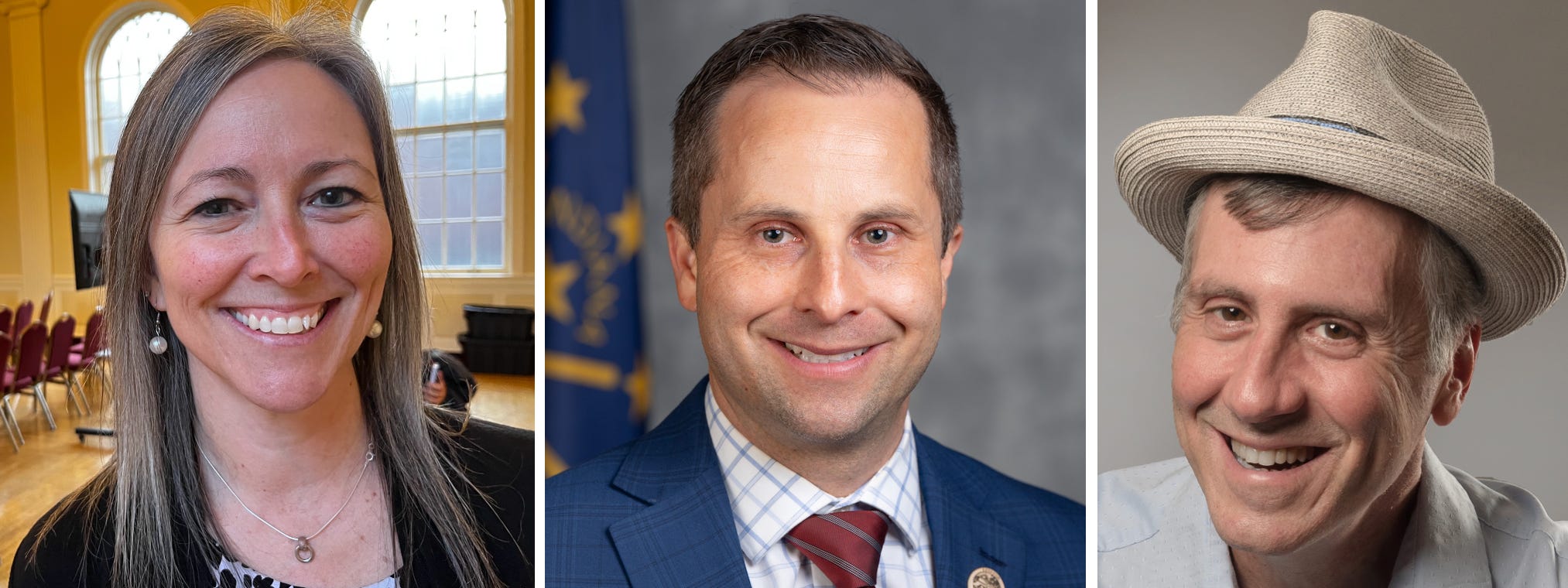
State Sen. Spencer Deery, looking for a second four-year term in Indiana State Senate District, 23, faces a primary challenge from Paula Copenhaver, former Fountain County clerk and Fountain County Republican Party chair, in the May 5 primary.
The winner will face Democratic candidate David Sanders, who teaches biology at Purdue and is a West Lafayette City Council member.
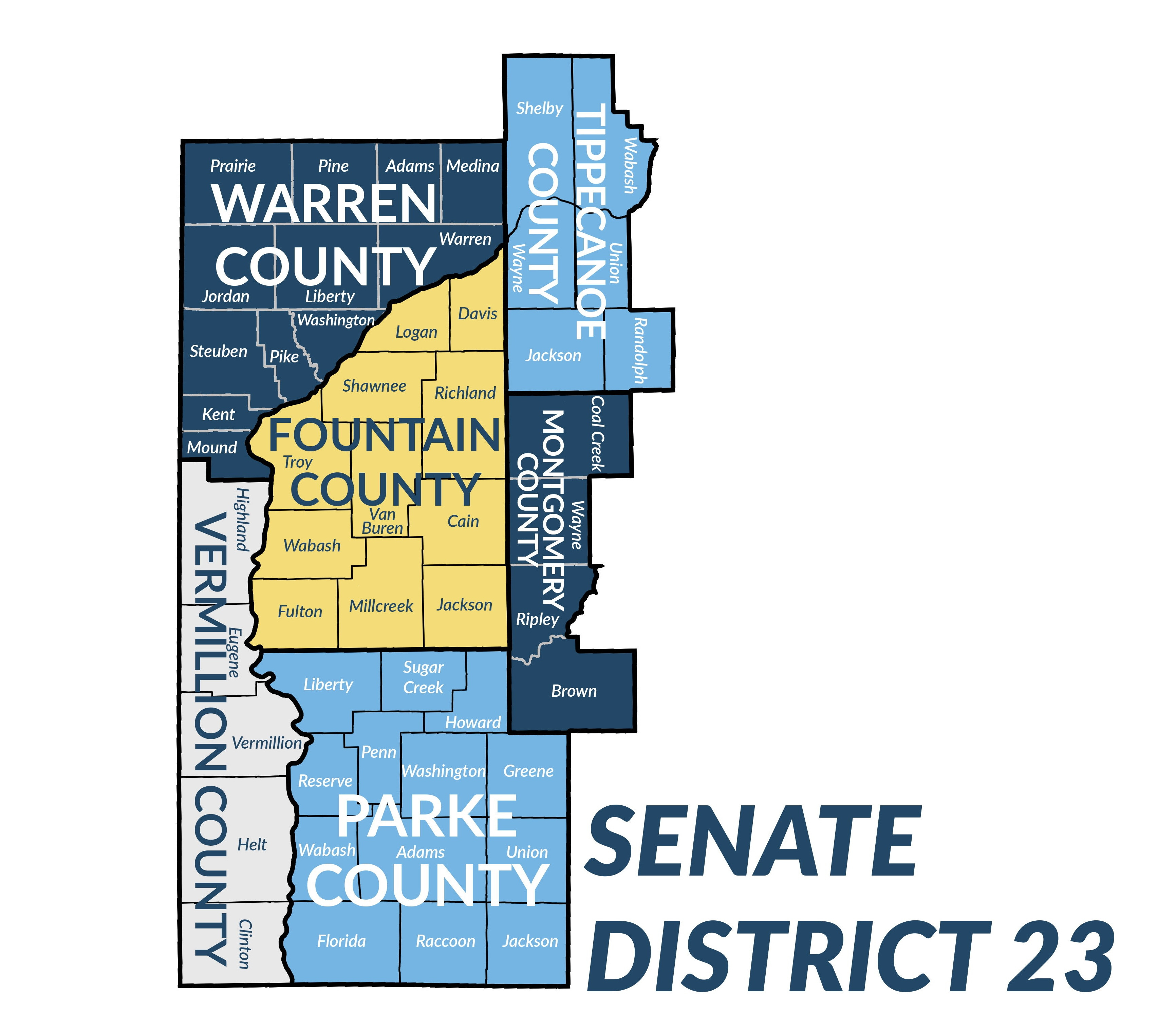
Indiana Senate District 23 includes six counties, spreading from West Lafayette to Vermillion County to the southwest.
Here, candidates answer questions about their approach.
For more: Find bios of each candidate, along with information about where and when to vote, at the end of this article. Watch in the coming days for more candidate Q&As in other races on Tippecanoe County primary ballots.
Why do you want this job? Why are you running now for this position?
Republicans
Paula Copenhaver: Hoosiers deserve real conservative representation. State Senate District 23 is a blue-collar, rural, and conservative district. Hardworking Hoosiers expect their state senator to vote with the district’s values in mind, but our state senator sided with the state and country’s most radical Democrats. I’m running to deliver a Hoosier First agenda – lowering property taxes, stopping the green energy scams, and protecting conservative Hoosier values.
Spencer Deery: It matters who represents us — not just because it’s helpful for Tippecanoe to have a strong voice in the majority party, but also because even a small number of elected officials can shape the tone and focus of our politics, for better or worse.
Four years ago, I promised that I would never sacrifice right and wrong for my own benefit. I promised to be honest with voters and to work for Hoosiers—and no one else.
I am not perfect. Some decisions are close calls. Some days require choosing which battles matter most. And I have learned firsthand that it is impossible to make everyone happy. But I have sought to represent all my constituents as best I can, and I have enacted policies that are making a difference in our schools and our communities. With that said, I am just getting started. I am asking for four more years to build on the momentum of my first term.
Democrats
David Sanders: I don’t see it as a job. I am the only candidate in this election who is not primarily a politician and yet has experience in legislating. I see being state senator as a public service. I will continue to work towards greater accountability and transparency from state government, to support home rule and oppose state preemption, to encourage citizen participation in governance, and to defend education against those who wish to undermine it with bills such as Indiana SB 202.
Name two of your top priorities for the position. And how will you handle them?
Republicans
Paula Copenhaver: Cutting property taxes is the number one priority. Too many Hoosiers have worked their lives to afford a home and ultimately are forced to sell that home because the property taxes are crushing them. We have to make the American Dream more obtainable by implementing a commonsense tax reform. The second priority is helping reduce the cost of everyday goods. We can lower the cost of food, housing, and everyday necessities by cutting burdensome regulations and letting businesses operate without intrusion from the government.
Spencer Deery: Affordability must be our top focus. We can’t fix all inflation from a state Senate seat, but Indiana can do its part to reduce the costs of healthcare, childcare, and essential services like utilities.
I also prioritize education and have enacted policies in support of Hoosier students every year. We need to do better at recruiting and retaining high-quality educators because once a student steps out of the home, nothing drives academic success more than the quality of the teachers.
Democrats
David Sanders: I will continue to oppose the corporate welfare that uses our taxpayer money to bribe companies to site data centers, semiconductor plants, and carbon-dioxide storage in communities that do not want them. I will continue to fight for clean water and against large-scale transfers of water. I will advocate for high-quality healthcare, public education, and broadband internet and telephone service for the rural areas of the district.
What’s the biggest challenge facing your district in the next four years? And how do you propose to address that?
Republicans
Paula Copenhaver: Our rural district is the target of Biden-era green energy scams, like carbon capture pipelines and solar panels. The state pushed green initiatives on rural Indiana and tied the hands of local government, preventing local Hoosiers from deciding what was best for their communities. Every decision that directly impacts a local community should be approved by the local governments and the people who live there.
Spencer Deery: Reasonable answers could include rising Medicaid costs and how that trend could consume education spending, the large number of Hoosiers who are struggling financially, or the challenge of road funding amid improved fuel economy and inflation.
But the biggest threat to the state will come more immediately on May 5 in the primary election.
Outside dark-money groups are trying to show they can control our elections and to intimidate local elected officials across the country into listening to them — not their voters. The ads may target me and my colleagues, but the real goal is to silence your voice and the voice of state governments nationwide.
If they succeed on May 5, they will have sent a message to state legislatures across the country that elected officials should fear Washington pressure more than their voters. That would be very bad for the independence of Indiana and bad for states’ rights nationwide. Fortunately, a victory in this election would eliminate the threat by making a clear statement that voters in state elections will not be manipulated into doing Washington, D.C.’s bidding.
Democrats
David Sanders: The biggest challenge we have is the lack of a senator who is independent and responsive. I will be an authentic state senator who represents the people of the district not merely some prominent political figure. I will achieve results not just take credit for the efforts of others. My approach is based on friendliness and respect towards other members of the community not hatred. In general, our rural areas have suffered from state neglect, and I will be a proponent for them. As I go door-to-door around the district, I do not find that people feel as if life has improved for them over the past four years.
How would you rate the property tax reform measures of Senate Bill 1, signed into law in 2025? What, if any, adjustments would you advocate in upcoming General Assembly sessions?
Republicans
Paula Copenhaver: The entire property tax system needs to be simplified. I’ve heard time and again that even state legislators struggle to understand the complexity of our tax code. That’s a problem. We need a simpler, more transparent system that works for taxpayers. The government must also control spending and live within its means. We must ensure Hoosiers, especially seniors and working families, aren’t taxed out of the homes they worked their entire lives to own.
Spencer Deery: I opposed SEA 1 because it was the wrong solution to the serious problem of rising property taxes. Under that law, tax relief would be short-lived, and it will benefit wealthy homeowners the most and harm rural communities the greatest.
There is no tax more unfair than property taxes because it’s not tied to your ability to pay them. Just because your neighbor sells property and your assessed value goes up does not mean you are wealthy enough to pay the tax. I also don’t like taxing behaviors we should promote, such as improving your property.
We need to think seriously about how we finance local government and embrace out-of-the-box ideas that are more tied to a resident’s ability to pay.
Democrats
David Sanders: Senate Bill 1 simultaneously raised net property taxes for lower-assessed homes and starved schools and municipalities for money. The whole taxation system in Indiana needs to be reconsidered.
What’s the best thing the Indiana General Assembly can do to improve access to quality health care? And how would you propose getting that done?
Republicans
Paula Copenhaver: Get government and third parties out of the way and let patients build relationships with their doctor and choose their health care provider.
Spencer Deery: I support access to telehealth and more independence for professionals like our pharmacists, physician assistants and advanced practice registered nurse practitioners. I trust Hoosiers to decide for themselves whether they should accept the risk of being seen by a professional with less training than a doctor.
In the rural communities I represent, this change would save lives and money, especially for patients with mental health needs. I also believe AI can play a role in supporting or even replacing the oversight that is currently nominally provided to these professionals by physicians, making more autonomy safer.
As for price issues, the system is broken. It’s inefficient and fails to harness the benefits of market forces like price transparency. A full fix will require federal reforms such as separating insurance from the employer model, but we can do our part as a state by pushing back against all the stakeholders: insurance companies, doctors, PBMs, drug manufacturers and large hospitals. All of these interests will need to accept some reforms they don’t love if we are going to get the health care system we need.
Democrats
David Sanders: I have been an active participant in local efforts to address the opioid crisis and homelessness. We need to see those struggling with addiction or homelessness as our fellow community members who need services rather than as criminals. Because of my scientific expertise on infectious diseases, I have also been a member of the Purdue Health Empowerment Initiative since its inception with a focus on healthcare in Indiana rural counties. I support healthcare debt reform legislation to reduce the major source of personal bankruptcy. Broadband internet access is essential for rural telehealth; I would guarantee its availability. The state needs to provide leadership for preventing the closure of rural hospitals, increasing access to maternity and mental-health services in rural areas, and addressing the general rural healthcare workforce shortages.
What would be the best thing, if anything, the state could do to solve what has been reported as a shortage of available, affordable child care in Indiana?
Republicans
Paula Copenhaver: Almost everything the government gets involved in tends to become more complicated and costly. Instead of creating more bureaucracy, the state should focus on cutting unnecessary regulations that drive up costs and limit access. However, we must ensure the child care provider is offering a safe and healthy environment for our children. We should also support solutions rooted in strong families, community service, and faith-based organizations that can help address this issue.
Spencer Deery: I was a proud co-author of SEA 2 (2024) to reduce unnecessary regulations that drive up the costs of childcare. I believe encouraging more home-based child care is the most affordable way to expand access but additional tax incentives for employers to offer or pay for childcare also should be pursued to the extent that it’s financially sustainable.
Democrats
David Sanders: We need paid parental leave for all workers in Indiana. In rural areas, it is essential that incentives and coordination be proved to businesses to support local child-care facilities. There needs to be state investment in childcare workforce development and training.
Should the General Assembly do anything that makes it easier or more difficult, either one, for developers of data centers to find suitable places to build and operate in Indiana?
Republicans
Paula Copenhaver: The government cannot force unwanted projects on our community. Our communities and local government should always have a say. But the state government does not have a right to force or fund a data center on the backs of Hoosier taxpayers. I will always support a local community’s right to decide what is best for their community.
Spencer Deery: Many of the companies backing data centers have budgets the size of nations. We should first eliminate the sales tax exemption the state gives these companies.
I also oppose any data center that would raise utility prices for Hoosiers, occupy prime farmland, use more water than is sustainable, or receive a state subsidy. Finally, we need greater transparency and a better understanding of how these companies impact utility rates.
I have authored bipartisan legislation addressing many of these concerns and plan to continue pursuing these commonsense policies.
Democrats
David Sanders: Tax incentives should not be provided to data centers. The Indiana Economic Development Corporation should not be allowed to recruit data centers. Community control of whether data centers are sited in their locales is paramount. Data centers should only be sited where locally generated energy and water resources reside.
How do you rate the K-12 education system in Indiana? What’s one thing you’d advocate to make it better, and how would you get that done?
Republicans
Paula Copenhaver: There is always room for improvement. I would advocate for teachers to get back to teaching the basics, less government involvement, and ensuring parents have a say in their child’s education.
Spencer Deery: Hoosier students have made impressive gains in recent years. Fourth-graders improved from 19th to 6th in the country for reading and eighth-graders climbed from 17th to 6th. Third graders obtained the largest increase in reading proficiency on record, with the state adding an additional 6,000 new readers.
At the same time, these gains are not enough. We need to see similar growth in math, civics, and postsecondary attainment. I believe after parents, teachers are the most influential support we can offer.
That’s why I have spent much of the last four years trying to find ways to get more quality professionals into the classroom and giving administrators more freedom to give them the pay and work environment that will keep them in the profession. I authored and passed multiple education bills to do just that.
In my next term, I will continue to focus on teacher pay and teacher support, with the goal of retaining the state’s top talent.
Democrats
David Sanders: Public school teachers have a major responsibility for educating the next generation of Americans. I advocate that public funds for education should be dedicated to public education. Improvements will not occur because of “merit pay” or lowering standards for teachers. There need to be ongoing opportunities for teachers to expand their skills and less state suppression of academic freedom and less state dictation of classroom content. Legislators who advocate for imposing their narrow values on all state schools through mandates are betraying their communities.
What, if any, changes would you make to loosen or tighten Indiana’s laws on hemp-based products?
Republicans
Paula Copenhaver: More research needs to be done before we change anything.
Spencer Deery: Minors can walk into gas stations and smoke shops today and buy Delta 8 products that will make them high. Some of the products are even marketed to children or of questionable foreign origin.
In the last two years I have supported and helped pass out of the senate legislation to end these sales. Unfortunately for Hoosier families, in both years, the House has killed these bills. Each took different approaches and I preferred the most recent bill, but either would be better than the status quo that fails common sense.
Democrats
David Sanders: I support the Purdue Hemp Project in its efforts to provide research-based information to aid in the development of hemp as an industry in Indiana and the Midwest. I do not believe in jailing adults for use of hemp-based projects.
If elected, you’ll likely have to navigate a Republican supermajority in both chambers of the General Assembly when representing your district. How will you do that, and what makes your prospects for success better than those of your opponent?
Republicans
Paula Copenhaver: As a Constitutional conservative, I believe we must represent the values and voices of our district. As a Christian, I’ll navigate everything like I have navigated my life – through prayer. I’ll always stand for the Constitution and defend the God-given rights of Hoosiers. I’m a firm believer that less government is better government. I’ll work to reduce taxes, cut regulations, and lower the cost of living for working families.
Spencer Deery: I have authored and passed meaningful legislation in each of my four sessions. I also have supported my district by shaping bills from behind the scenes in ways that the public never sees.
It takes time to learn the process and to develop relationships with colleagues, but these are essential parts of legislating. I have already put in this work.
In the state Senate, seniority is not everything but it does matter, and I am well positioned to accept more influential leadership positions in the near future following my re-election. The alternative choice for the community would be to start from scratch, with no guarantee, if not a likelihood that my replacement would ever be in such a position.
Democrats
David Sanders: I worked with voters and organizations across the political spectrum to oppose the transfer of 100 million gallons of water a day from aquifers adjacent to the Wabash River for the LEAP Lebanon project. Together we succeeded despite being told that it was a done deal. I am the only candidate who has a history of working with such a broad coalition and achieving results. I believe that empowering the public to express their concerns is democracy in action, and as a state senator, I will continue to encourage such mobilization of the community to promote its welfare.
Name two specific things that separate you from your opponent and why those matter.
Republicans
Paula Copenhaver: I’m the only candidate in this race that is a lifelong Hoosier. I was born, raised, and still live in rural Indiana. I understand the challenges our rural communities face when Indianapolis political elites force restrictive and harmful regulations onto our communities. As a State Senator, I’ll take a stand to protect rural Hoosiers.
I’m a lifelong conservative Republican who will always fight for our Constitution and the future of our nation. I’m proudly endorsed by President Donald Trump, Sen. Jim Banks, Attorney General Todd Rokita, and other strong conservative leaders. I will always fight to put Hoosiers first.
Spencer Deery: I believe integrity is the supreme value we should ask of our elected officials. That includes refusing to work for or represent anyone but my constituents, and I certainly won’t ever be owned by Washington, D.C.
I believe the job of an elected official is to try to represent the entire district to the best of their ability. Politicians who cater only to one faction or one region of the district do a disservice to those they are supposed to represent.
Democrats
David Sanders: I am the only candidate with both experience and independence — I am not a stand-in for either a former governor or a current lieutenant governor. I am the only candidate who respects other people’s family, marriage, and childbearing decisions. I am the only candidate with an acknowledged record of supporting public education, freedom of speech, academic freedom, and the local international community. I am willing to participate in forums to inform the voters.
Bios
Paula Copenhaver
Party: Republican
Age: 53
Occupation: Government Affairs Director, Lieutenant Governor’s Office
Educational background: Indiana University
Past elected positions, if any: Fountain County Clerk, Covington City Council, Fountain County GOP Chairman
Community boards or other community leadership and service: Covington Redevelopment Commission
Immediate family: None listed.
Your campaign site online: www.copenhaverforindiana.com/
Spencer Deery
Party: Republican
Age: 43
Occupation: Higher Education Administration
Educational background: Bachelor’s in communications; Master’s in Public Administration (Public policy specialization)
Past elected positions, if any: The State Senate is the only office I have sought or held.
Community boards or other community leadership and service: Midwest Higher Education Compact Executive Committee; active in the leadership of our local church congregation
Immediate family: Married to Julia for nearly two decades. We have three school-aged children.
Your campaign site online: spencerdeery.com
David Sanders
Party: Democratic
Age: 65
Occupation: Associate Professor of Biological Sciences, Purdue University
Educational background: B.S., Molecular Biophysics and Biochemistry, Yale College, Ph.D., Biochemistry
Past elected positions, if any: West Lafayette City Councilor-At Large, 2016-Present
Community boards or other community leadership and service: Founder and Chair of Stop the Water Steal and President of the Wabash River Conservancy
Immediate family: Wife, Sharon, three sons, two grandchildren.
Your campaign site online: davidsandersindiana.com
ABOUT THE MAY 5 PRIMARY
Early voting ahead of the May 5 primary election runs April 7 to May 4 with contested races on Tippecanoe County ballots for U.S. House, several Indiana General Assembly seats, Tippecanoe County commissioner and Tippecanoe County Council seats, township position and state convention delegates. Voters may choose a Republican or Democratic ballot, but not both, when checking in at the voting site.
Voter registration/ballots
To check your voter registration and to see candidates who will be on your R or D ballot, go to the Secretary of State’s portal at www.indianavoters.com.
Early voting sites
In Tippecanoe County, registered voters may cast their ballot at any vote center.
April 7 to May 4: Tippecanoe County Office Building, 20 N. Third St. in Lafayette. Weekday hours: 8 a.m.-4:30 p.m. April 7-10, April 13-17, April 20-24, April 27-May 1. Other hours: 9 a.m.-4 p.m. April 25 and May 2; and 8 a.m.-noon May 4.
April 18: McAllister Recreation Center, 2351 N. 20th St., Lafayette. Hours: 9 a.m.-1 p.m.
April 21: Córdova Recreation Center, 355 N. Martin Jischke Drive, West Lafayette. Hours: 10 a.m.-4 p.m.
April 23: First United Methodist Church, 1700 Mitch Daniels Blvd., West Lafayette. Hours: Noon-5 p.m.
April 25: West Point Fire Station, 4949 Indiana 25 S., West Point; Otterbein United Methodist Church, 405 Oxford St., Otterbein; and Clarks Hill Christian Church, 9510 Pearl St., Clarks Hill. Hours: 9 a.m.-1 p.m.
April 28-May 1: Tippecanoe County Fairgrounds, 1406 Teal Road, Lafayette; Wea Ridge Baptist Church, 1051 E. County Road 430 South, Lafayette; Eastside Assembly of God, 6121 E. County Road 50 South, Lafayette; and John Dennis Wellness Center, 1101 Kalberer Road, West Lafayette. Hours: Noon- 6 p.m.
May 2: Tippecanoe County Fairgrounds, 1406 Teal Road, Lafayette; Wea Ridge Baptist Church, 1051 E. County Road 430 South, Lafayette; Eastside Assembly of God, 6121 E. County Road 50 South, Lafayette; and John Dennis Wellness Center, 1101 Kalberer Road, West Lafayette. Hours: 9 a.m.-3 p.m.
Election Day vote centers
Voting on Tuesday, May 5, will be 6 a.m.-6 p.m. Registered voters in Tippecanoe County may choose any of these sites.
Lafayette
Tippecanoe County Fairgrounds, 1406 Teal Road
Lafayette Community Church of the Nazarene, 3801 Union St
The Grove Covenant Church, 3600 S. Ninth St.
Tippecanoe County Historical Association History Center, 522 Columbia St.
Wea Ridge Baptist Church, 1051 E. County Road 430 South
Eastside Assembly of God, 6121 E. County Road 50 South
Northend Community Center, 2000 Elmwood Ave.
West Lafayette
Faith West Community Center, 1920 Northwestern Ave.
Córdova Recreation Center, 355 N. Martin Jischke Drive
Connection Point Church, 2541 Cumberland Ave.
John Dennis Wellness Center, 1101 Kalberer Road
Outside Lafayette/West Lafayette
Shadeland Town Hall, 2485 Indiana 25 West, Shadeland
Tippecanoe Township Volunteer Fire Station No. 2, 448 W. County Road 650 North, West Lafayette
Dayton Gathering Point Church, 7201 Wesleyan Drive, Dayton
Battle Ground Fire Station, 112 North St., Battle Ground
On the ballot
Here are candidates who will be on Tippecanoe County ballots in the May 5 primary. (* = incumbent)
Tippecanoe County
Commissioner, District 1: Julie Roush and James Waters, R; Andrea Burniske, Travis Dowell, Justin Kendall and AR Lane, D
County Council, District 1: Ben Murray*, D; Trent Richter, R
County Council, District 2: Jody Hamilton* and Jonathan Chapin, R
County Council, District 3: Lynn Beck, R
County Council, District 4: Lisa Dullum*, D
County Clerk: Abby Myers and Carrie Sanders, R; Karan Benner, D
Assessor: Anthony Hustedt-Mai, R; Kaitlyn Butler, D
Auditor: Jennifer Weston*, R; Eric Grossman, D
Recorder: Kristy Martin*, R; Monica Casanova, D
Prosecutor: Jason Biss, R
Judge, Superior Court 1: Kevin McDaniel*, R
Judge, Superior Court 2: Sarah Wyatt, R
Judge, Superior Court 4: Matt Sandy*, R
Judge, Superior Court 5: Kristen McVey*, R
Judge, Superior Court 7: Dan Moore*, R
Indiana General Assembly
House District 13: Matt Commons*, R; Brenna Geswein and Ed Moyer Jr., D
House District 26: Chris Campbell*, D; Magdalaine Davis, R
House District 27: Sheila Klinker*, D; Tracy Brown and Oscar Alvarez, R
House District 38: Heath VanNatter* and Mark Hufford, R; and Nate Stout, D
House District 41: Mark Genda*, R; Jackson Hayes, D
Senate District 22: Ron Alting* and Richard Bagsby, R; Natasha Baker and Marlena Edmondson, D
Senate District 23: Spencer Deery* and Paula Copenhaver, R; David Sanders, D
Congress
U.S. House, District 4: Jim Baird*, Craig Haggard and John Piper, R; Drew Cox, Roger Day, Darin Griesey, Thomas Hall Jr., Robert Lovely, Joe Mackey, Jayden McCash, Paul McPherson and John Whetstone, D.
For a look at all candidates on Tippecanoe County primary ballots, including those for township trustee, township boards and state delegates, here are links to Democratic candidates and Republican candidates.
Thank you for supporting Based in Lafayette, an independent, local reporting project. Free and full-ride subscription options are ready for you here.
Tips, story ideas? I’m at davebangert1@gmail.com.
There's no way on God's Green Earth I will vote for someone who has kissed the Orange Con Man's ring. Deery is far from perfect but at least he listens to his constituents and not a demagogue in D.C.
A notable use of a Caesar Cipher was the name of the HAL computer in 2001: A Space Odyssey.
In that spirit then, can Councilman Sanders disclose if he or his colleagues ever signed a MEB related to TL Izojy or QSG?
Otherwise, when it comes to voting for you: I’m sorry, Dave. I’m afraid I can’t do that. I think you know what the problem is just as well as I do.