

Support for this edition comes from French Knot, presenting the final day of its annual warehouse sale Saturday, Dec. 13, at 525 Wabash Ave. in Lafayette. Learn more here.

Thanks for ongoing support from Based in Lafayette sponsor Long Center for the Performing Arts in downtown Lafayette. For tickets and details on all the shows and events, go to longpac.org.

THIS AND THAT/OTHER READS: WHAT THEY WERE SAYING AFTER INDIANA SENATE REJECTED TRUMP’S REDISTRICTING PLAN
Here are more reads and fallout after the Indiana Senate on Thursday rejected President Donald Trump’s campaign to redraw maps of Indiana’s nine U.S. House districts in hopes of orchestrating a 9-0 Republican delegation from the state.
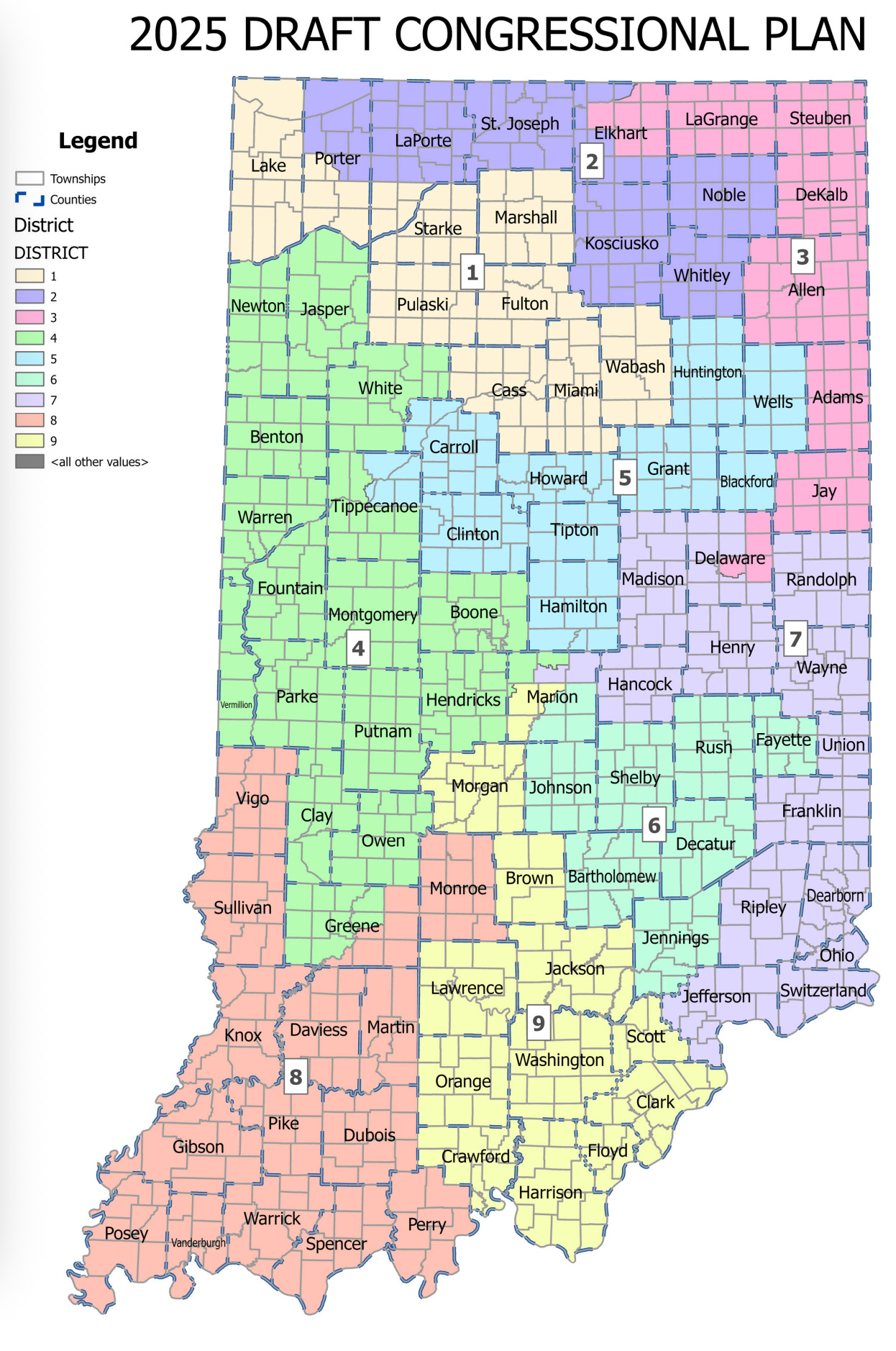
In Tippecanoe County, Sens. Ron Alting and Spencer Deery, both Republicans, split on the bill. Alting voted yes. Deery voted no. Here’s a look at why, along with reaction from Indiana House members who represent parts of Tippecanoe County:

From Politico reporter Adam Wren: “Indiana Republicans withstood immense pressure from President Donald Trump, ignoring anonymous threats on their lives as they defeated his plan to redraw the state’s congressional map and dealt him one of his most significant political setbacks since his return to the White House.” The rest here: “Indiana GOP rejects Trump’s map in major blow to his gerrymandering push.”
From Indianapolis Star reporter Hayleigh Colombo on a pissed off Gov. Mike Braun, who was challenged by President Donald Trump to get the redistricting job done but ultimately couldn’t make the sale at the Statehouse and was now ready for retribution: “Gov. Mike Braun is now in open political warfare with half of the Indiana Senate’s Republican caucus after members of his own party voted against President Donald Trump’s redistricting push. However, while Braun criticized what he described as a “small group” going against the president’s wishes, the “no” votes ended up comprising more than half of the Senate’s Republican caucus, signaling that Braun’s encouragement did not prove convincing to members of his own party.” Read the rest: “Braun threatens GOP defectors after Indiana Senate decisively votes down redistricting bill.”
From Washington Post reporter Patrick Marley: “Since this summer, Republicans in four other states have rejiggered their maps at Trump’s urging to give their party as many as nine more seats — part of a larger plan aimed at retaining power in Congress after next year’s elections. But in Indiana, a contingent of GOP state senators politely but persistently said no. And Trump’s relentless pressure appears to have backfired. … ‘Hoosiers are very independent,’ said (Republican Sen. Vaneta) Becker. ‘And they’re not used to Washington trying to tell us what to do.’” For the rest: “Trump’s redistricting effort fails in Indiana as GOP lawmakers deliver rare rebuke.”
From the New York Times reporter Mitch Smith: “The 19 to 31 vote was a highly public defeat for Mr. Trump, who has spent significant political capital pushing for redrawn maps in Republican-led states and who repeatedly threatened political consequences for Indiana Republicans who did not fall in line. The defiance of Mr. Trump comes as he faces other signs of rifts within his own party. The rejection of the map in the State Senate, where Republicans hold 40 of the 50 seats, followed months of presidential lobbying that turned increasingly pointed in recent weeks as it became clear that some holdouts were not budging. Mr. Trump had called some of them out by name on social media, openly questioning their loyalty to the party and pledging to back primary challengers against them.” For more: “Indiana Lawmakers Reject Trump’s New Political Map. Republicans hold an overwhelming majority in the Indiana Senate, but more than a dozen of them defied the president’s wishes, voting against a map aimed at adding Republicans in Congress.”
From CNN reporter Eric Bradner, who spent several years with the Indiana Statehouse press corps: “It was clear on Thursday that a pressure campaign waged by the White House and its allies had backfired. A state that Trump won by nearly 20 points in 2024 gave him a massive political black eye, rejecting a push to create two more GOP-friendly US House seats that could have helped Republicans retain the House majority in next year’s midterms. Several Republican senators noted on Thursday that constituents opposed a mid-decade redrawing of US House maps and that they questioned the wisdom or the precedent of joining the national redistricting battle. But a number of Republicans, including people who voted for the president three elections in a row, also gave deeply personal reasons over the last several weeks.” For the rest: “The deeply personal reasons why many Indiana Senate Republicans said no to Trump.”
Adam Wren, in The Playbook in Politico, reported on the influence of Mitch Daniels, former Indiana governor and Purdue presidents, had in the background. “While he didn’t make calls, he did take them from senators as they worked through their decisions, he told Playbook. “I’m just very proud of the gumption that a lot of our folks showed,” said Daniels, who came out early against redistricting.” Here’s more from Wren’s reporting.
Daniels weighed in with an op-ed Friday in The Washington Post: “My state’s Senate, not often the subject of national attention, earned some on Thursday by declining to enroll Indiana in the bipartisan national embarrassment of mid-decade gerrymandering. There will be a tendency to overread the event’s significance by those eager for signs of the president’s political demise, but neither is it a moment without broader meaning. Observed firsthand, the Senate’s action reflects less a rejection of the president or his agenda than a few traits prominent in Hoosier culture and history. One is an innate sense of fairness — an aversion to rule-bending to gain an unearned advantage in any realm. Another is an instinctual rebellion against being ordered around, especially by outsiders.” Read the rest of it here: “Hooray for Hoosiers, cynical GOP redistricting fails.”
What sort of federal payback will Indiana get? Lt. Gov. Micah Beckwith posted on social media Thursday night, apparently confirming reports ahead of that days vote the Trump had warned senators to not count on federal money if they voted no. Beckwith, who called senators spineless for ditching the plan, later deleted that post, and others in the Indiana General Assembly said they hadn’t received those type of threats. (Beckwith returned with a treatise on disloyalty, writing on a social media post Friday morning that pictured the 21 Republicans who voted against the bill: “The war didn’t start today. But today made it unmistakably clear who’s willing to stand… and who isn’t.”)
Trump targeted Senate President Pro Tem Rodric Bray, telling reporters Thursday afternoon: “You had one gentleman, the head of the Senate, I guess Bray, whatever his name is … He’ll probably lose his next primary, whenever that is.” Bray, for his part, said he had faith that “Indiana will continue to function.” U.S. House Speaker Mike Johnson told reporters in Washington that Indiana’s vote was “inconsequential” to the effort to stack Republican seats in the 2026 midterm elections. For more, here’s Casey Smith reporting for the Indiana Capital Chronicle: “Backlash intensifies after Indiana Senate kills Trump’s mid-decade congressional redistricting push. Trump allies and conservative groups warn Indiana could lose federal dollars after redistricting vote.”
From Indianapolis Star reporter Kayla Dwyer on where Indiana’s vote left a national push for congressional seats in the 2026 election: “Though Indiana only had two seats to offer, the White House was very much counting on them. Now, the math could end up wielding Republicans little to no advantage at the end of all this effort, since Democratic states have also drawn their own new maps ― and there are still more states considering action.” For more: “How Indiana’s redistricting rejection affects Trump’s push nationwide.”
The vote Thursday means Jim Baird, who represents Tippecanoe County and surrounding counties among those in Indiana 4th District, had joined other Republican members of Congress calling for redrawing the maps. As he faces a primary challenge, Baird posted his reaction on social media: “I have been supportive of the redistricting process because Hoosier values should not be sidelined by the far-left. I am proud to stand with President Trump as we deliver historic wins for the American people by securing our border, cutting taxes, and restoring the American dream. I will continue to faithfully serve the people of Indiana’s Fourth Congressional District and represent Hoosier voices in Congress.”
Maybe the happiest in Tippecanoe County about the vote was Mike Smith, a longtime elections board staffer who had been warning that the proposed maps – which cut jagged lines through Lafayette and West Lafayette, splitting neighborhoods, school districts and precinct lines – were fraught with election errors waiting to happen. (State Sen. Spencer Deery referenced Smith, though not by name, during testimony on the Senate floor Thursday: “The Republican election board staff member in my county with 40 years of experience tells me he would swear before a court of law that it’s not that some Hoosiers might get the wrong ballot, it’s that some Hoosiers will get the wrong ballot, and that is true across the state.”) After Thursday’s vote, Smith said: “The Indiana Senate on Indiana’s birthday gave the gift of Hoosier common sense to the state’s voters. Aside from any of the political arguments, which I have studiously refrained from, several senators noted the challenges election workers around the state pointed out in this fractured, administratively flawed and unfunded bill and factored that into their decision.”

PURDUE TRUSTEES OK AI GRADUATION REQUIREMENT, $8.3M DEAL FOR DELTA GAMMA SORORITY PROPERTY
Here are a few takeaways from Friday morning’s Purdue trustees meeting:
GRAD REQUIREMENT COMING FOR AI COMPETENCY: Signaled this semester by President Mung Chiang, a graduation requirement built around the ability to understand and use artificial intelligence will be introduced in time for the arrival of freshmen in fall 2026. Purdue trustees agreed to the idea, still being worked out to greet undergrads in the future class of 2030, Friday.
