

Support for this edition comes from Purdue Musical Organizations, presenting the 92nd annual Purdue Christmas Show. The Christmas Show will shine Boilermaker bright with an all-student cast, festive music and dazzling performances. Tickets are now on sale for the Dec. 6-7 shows, where audiences of all ages will come together to celebrate the spirit of the holiday season at this timeless Purdue tradition. Get your tickets here.

Thanks, also, to Stuart & Branigin for continued support of the Based in Lafayette reporting project.

Q&A: LAFAYETTE BREWING CO. OWNERS ANNOUNCE CLOSING TIME AFTER 32 YEARS
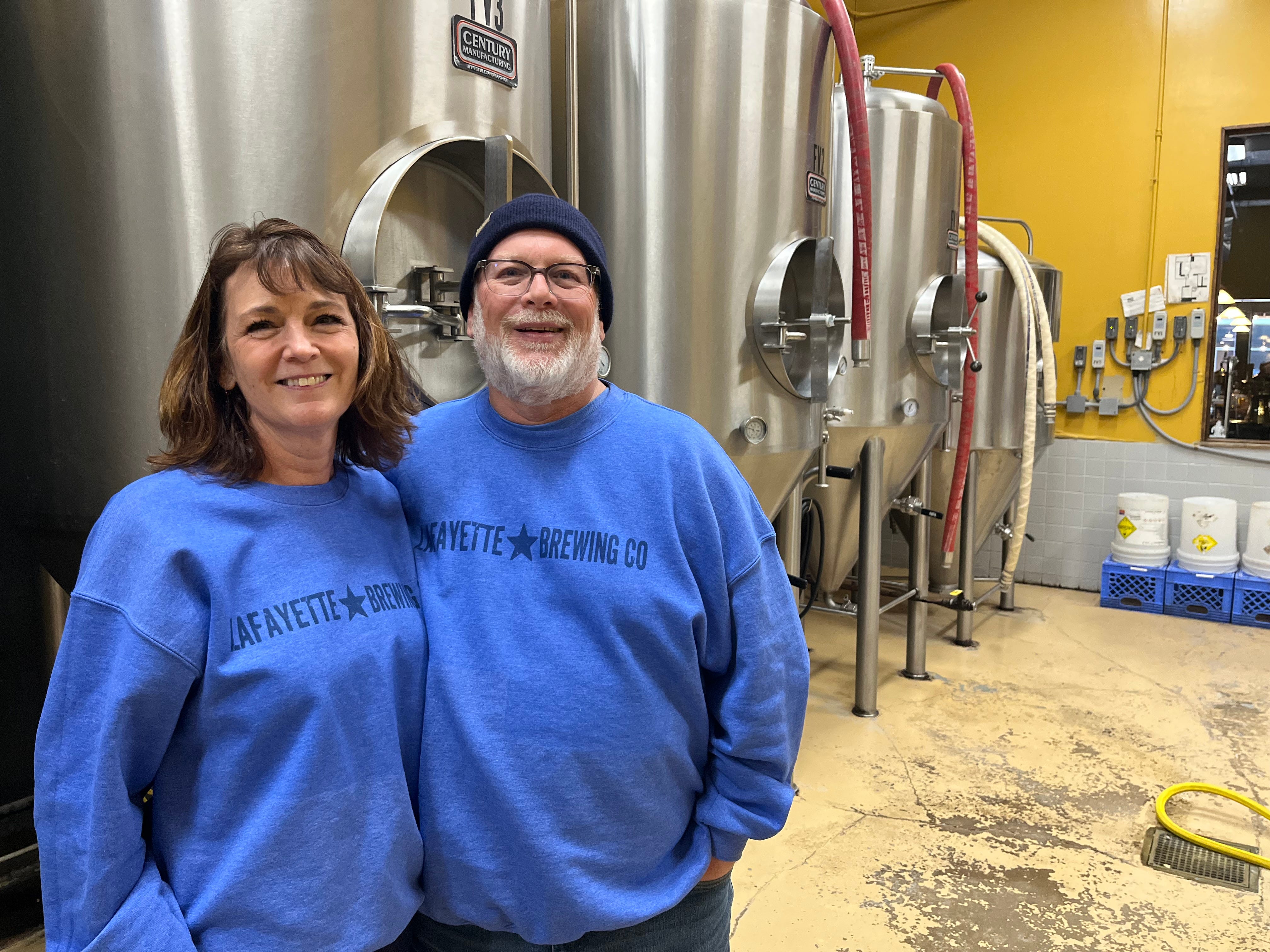
Memories were flowing – and tables were full at 622 Main St. – Wednesday after Lafayette Brewing Co. owners Greg and Nancy Emig announced that morning that they’d close the brewpub on Dec. 20.
Opening in 1993 in a former furniture showroom in downtown Lafayette, LBC was the second brewpub in Indiana and the first with a small brewery permit in the state, in the early days of what became a burgeoning craft beer and brewpub scene in town and across the state.
Question: Everyone’s picking up on the post this morning, sharing all kinds cheers to LBC and memories about this place. How’s today been for you?
Greg Emig: It’s been a tough day.
Nancy Emig: Emotional.
Question: The business has been listed for sale, right?
Greg Emig: The building, but not the business necessarily. Now, we’ve talked to some people that had expressed some interest, but nothing serious at this point. Everybody’s kind of looking at the economy and trying to figure out where it’s all going. And this announcement has gotten some interest. We’ve had been contacted by three different people today.
Question: So, why now? What was the timing?
Greg Emig: It was a combination of everything, really. I mean, we look at business since COVID and it’s been tough. The labor market is brutal. We own a 135-year-old building, and it takes a lot to maintain it. It is an expensive entity in and of itself, just trying to keep up with the building. If we were a big corporation, we’d have been shut down years ago because of stockholders. But obviously, because it’s our family business, we’re plugging along with it as best we can. I think it’s a combination of everything. A lot of things have changed, and we’re old. We’ve been doing this for 32 years.

Question: That’s the amazing part about that. I think back to seeing you coming down to The Pub, when it was open and still going big, after working here on the building and talking about what you guys had in mind. Let’s go back to the beginning. Why Lafayette and how did you get to that point?
Greg Emig: It was kind of a perfect storm. We looked all over the Midwest for where we were going to do this. And obviously we were Purdue grads, so we had some connections. But I think the strongest connection was probably the home brewing community when I worked at the Knickerbocker. That was the only place in here in town you can get a “different beer,” if you would. But there was also a group of guys, core guys who used to hang out at the ‘Bocker. You know, 22-year-old me was enthralled by the fact that these guys were making their own beer, going to the Great American Beer Festival and doing that stuff. I was like, Hell, I’m gonna try this and started making beer in the kitchen. The brewing part of it kind of took off from there.
Nancy Emig: We looked around at many different places. We were always like, What about Lafayette? Let’s go back and check it out. And, you know, a lot of the places that we went into were just like, You want to do what? And you’re going to bring this big facility to manufacture? We looked at Miami of Ohio. They were like, What are you doing?
Greg Emig: They thought we were going to be the next Miller plant. Well, that’s not quite it.
Nancy Emig: When we came to Lafayette, it was open arms. People were so interested.
Greg Emig: Not that they knew any more about what we were trying to do. But I think it was just good timing in Lafayette, which was trying to find things that helped the downtown work. I think that’s probably why the attitude was a little different here than it was at some of the other places. The other real factor was the cost. We looked a little bit to Kansas City, and we’d have spent more on a building there that was in really bad shape than we would have on the whole project competed here. There were limitations on the size of a community that we’re going to be able to go into. But we always wanted a university community, because we felt we had a pretty different concept at that time, and we wanted people that had maybe traveled a little bit more, had a little more experience with different styles of beer than your average Miller Lite drinker had at that time.
Question: I think you told me once there was a connection to The Pub having Sierra Nevada on tap in those days. Is that a true story?
Greg Emig: True story.
Question: What was it about Sierra Nevada at The Pub?
Greg Emig: Because at that time, Sierra Nevada was the craft beer. It wasn’t even called craft beer – it was called a micro-brew at that time. It was the one. And I thought, man, if they can sell this at The Pub – I don’t even know if they’re really sold much of it at The Pub, I think we drank it all – for us that was like, OK, this community is ready for a different, good beer product.
Question: What was it at the time, with this new concept in beer, that made you think it would work in Kansas City, Miami, Ohio, or Lafayette, for that matter?
Greg Emig: Broad Ripple (Brew Pub). We saw what (founder) John (Hill) did there.
Nancy Emig: They took us under their wing and helped us do everything we did here.
Greg Emig: It was our experience with the Broad Ripple Brew Pub that showed us that this was legit. That you could make really good beer and have a very small brewery, and you didn’t have to distribute, didn’t have to put it in packages, you didn’t have to do any of that. And people would appreciate a local brewery.
Nancy Emig: It’s funny, he says, “a little brewery.” When we started, we were looking at something the size of a bar, serving short order food. We got this home brewer gone mad to give him a place like this to make his beer.
Question: How much did you end up producing?
Greg Emig: That’s changed a lot over the years, because of the increase in breweries. When we were the only game in town, we were doing about 900 barrels a year, which still isn’t, in the grand scheme of things, a lot of beer. But it was all sold in house, so that was a pretty good thing for us. As more breweries opened, our production numbers dropped and dropped. Now we’re doing about 450 barrels, so about half of what we were doing back then. But it’s not just the other breweries these days. It’s consumers changing what they drink. Less alcohol being consumed. Way more of these THC beverages. And who knows where that’s going to go? Certainly, the economy comes into play these days. We’ve been through that a little bit, obviously, through the Great Recession and some of this other stuff that’s happened over the years.
Nancy Emig: But we’re getting old.
Greg Emig: Yeah, you combine that with all the rest of this stuff, and if we were 50 years old, would we be taking a different approach? Probably. But we’re not.
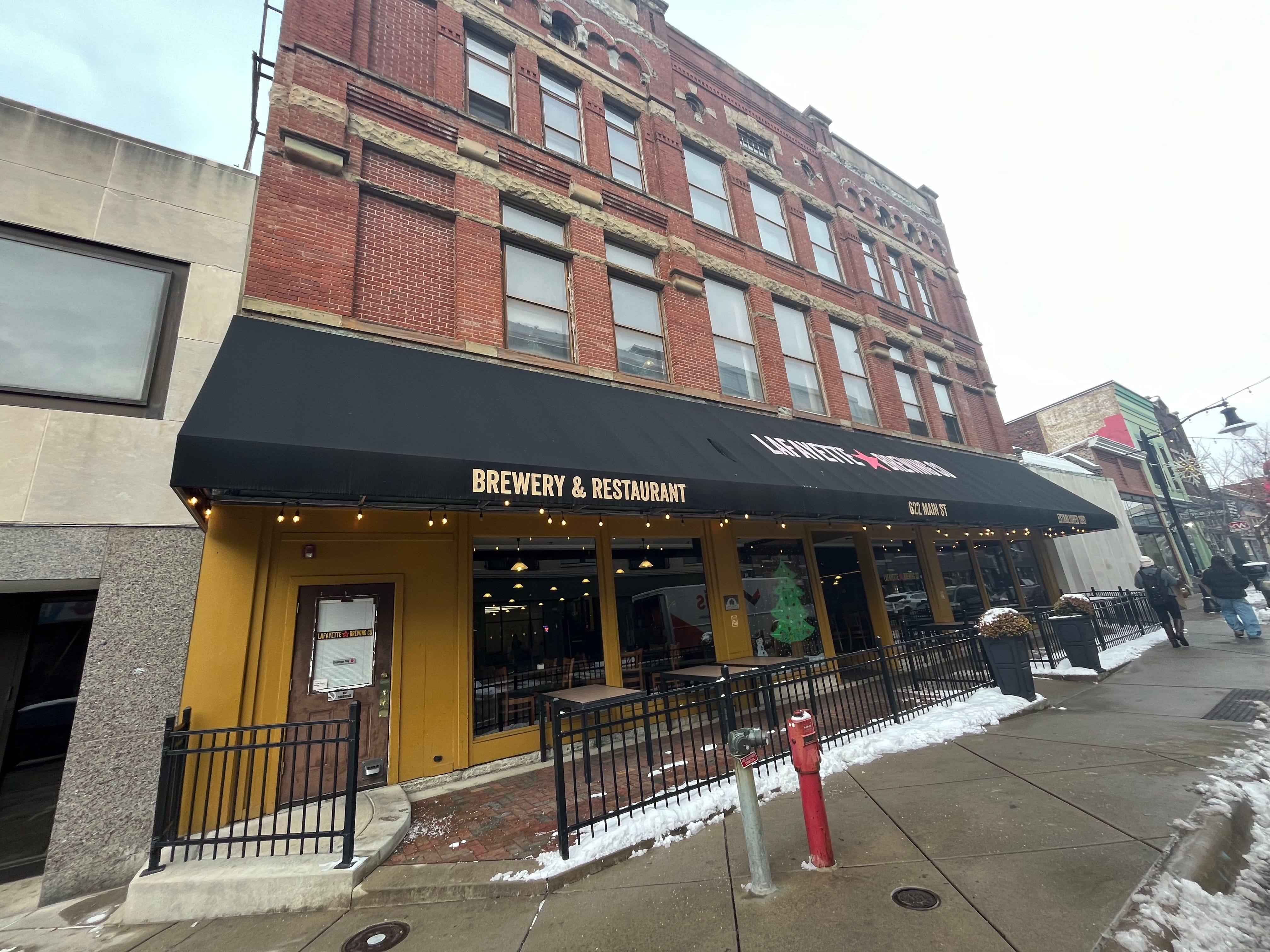
Question: I remember when you guys took on the old Kaplan’s Furniture space, taking on this building. It’s a big place.
Nancy Emig: And it was overwhelming.
Greg Emig: We had no idea. It was naivety. We were like, OK, we got this building, and now what are we going to do with it? The restaurant, as Nancy mentioned, was three times the size we thought it was going to be in our initial plans. The brewery, even though it kind of started small, we ended up adding on to it and doing some other things. The pressure to grow and do those kind of things was always there, in a good way.
Nancy Emig: The thing that we always said was is we wanted to stay ahead of the train, like a train was always on our ass. We just wanted to keeping moving with the times and introduce new things, change up the menus, do what it took. Starting up the second floor? Live music? We’ve got the space, let’s do it.
Question: Watching people react today since your announcement, there’s talk about coming and getting beer, about meeting people, finding the one they’d marry and all the rest of it. But music upstairs is a big part of the memories today.
Nancy Emig: It wasn’t something in the beginning that we thought, oh yeah, we want to open up a live music venue. It’s just one of those things where we just kind of grew into it and with it.
Question: Downtown has changed all around you since 1993.
Nancy Emig: There were tumbleweeds blowing down Main.
Greg Emig: There were a lot of papered-up buildings.
Nancy Emig: There was us, Sarge Oak, Knickerbocker, Preston’s …
Greg Emig: From a restaurant perspective, yeah.
Question: How do consider your role in building up downtown to what it’s like 30-plus years later?
Greg Emig: I’d like to think we were a good addition to the community. I mean, it was something new, unique and, obviously, it caught fire at some point and spread across the country, if not the globe. There’s craft beer everywhere now. So, did it help? Yeah, I think it helped bring some people downtown. I think the city has always had pretty good leadership and good plans for downtown in terms of developing it and the streetscape and all this kind of stuff. We couldn’t have imagined that when we opened up. You look down Main Street now, it’s a model Main Street. I don’t say that lightly, because there’s not a lot of communities that you can go downtown and see this kind of vibrant downtown, especially in towns of this size. And it happened here for a while when the malls were built and everything, everybody left downtown areas, and that was tough on a lot of small communities. I think Lafayette was ahead of the curve in terms of focusing on their downtown and trying to bring that back.
Question: Posts are going on about LBC as the O.G. brewery in town. You’ve had a family tree of brewers come out of this place.
Greg Emig: For sure. Chris Johnson, right up the street at People’s, he brewed here for eight years. We have a good friend out in White Salmon, Washington, Doug Ellenberger who runs Everybody’s Brewing Co. out there. DJ McAllister had Black Swan (Brewpub) down in Plainfield. Yeah, we’ve got folks that spent a little time in the brewery and have gone out and done their thing. Same with people that have come through the restaurant. Scott Trzaskus at East End Grill was on our original staff when we opened up. Gabby Meyer, who opened bistro 501, was one of our managers for a while. Half the staff at the Black Sparrow has been through our place. It’s one of those things where it’s kind of nice that we’ve got these folks that have kind of spawned out from our place and done their own thing.
Question: Was there a final straw that led to that post today, that, OK, it’s time?
Greg Emig: I don’t know if there was a final straw. We met with a lot of people over the last six months, trying to wrap our heads around where we were going, where the industry is going, where the economy is going. Like I said, most corporations would have made this decision years ago. But we’re not a corporation. It was just a combination of everything.
Nancy Emig: It is all-consuming, but it’s a passion. Like we’ve said, it’s a family. It’s been more than just a business or a job. It’s been a way of life. It’s been our dream. So making the decision was hard.
Greg Emig: Most of our friends are people that we’ve met here at the Brewing Company, whether they were guests, employees, vendors, in some cases.
Question: Is it retirement time for you two?
Nancy Emig: Right now, we’ve got a lot of cleanup in the building. And we got a big project at home, because most of his maintenance and work has been taking care of this place. So we’ve got some projects on the horizon.
Greg Emig: We’ve got a good year-plus worth of work on our schedule right now, again, just getting this place in shape. It’s kind of ironic that the announcement has all of a sudden brought people out of the woodwork who are saying, Oh, hey, we’re interested. Hopefully, that’s a good thing and maybe somebody will step in and pick it up.
BUILDING BiL HOLIDAY PLAYLIST: WHAT’S ON YOURS?
Through Christmas, BiL will curate three songs a day from readers. The assignment isn’t necessarily about the best or most iconic songs of the season. Just songs that you’d want in the mix and why they belong. Enjoy.
Colin William
Colin William is a teaching professor in Purdue’s Department of Psychological Sciences.
“Il est né, le divin Enfant,” Ashley MacIsaac – When I was a kid growing up in Scotland our school would have singalong music lessons on reel-to-reel tape, and at the holidays they’d do international Christmas songs. This is the song I remember to this day, from the great Canadian fiddler Ashley MacIsaac.
“Santa Claus and His Old Lady,” Cheech and Chong – My family moved to the U.S. in the mid-‘80s and this track, even though not a song, was a staple on classic rock radio stations around the holidays
“Der Trommelmann,” Marlene Dietrich – Some people love “The Little Drummer Boy,” others hate it, and this is perfect for both – those who love it get a beautiful rendition, and those who hate it can take in Marlene Dietrich’s amazing voice without the distraction of understanding the lyrics. (Also, anyone who doesn’t know about Marlene Dietrich should read this capsule bio.)
Your turn
What three songs are going into your holiday/seasonal playlist this year? If you’re game share, here’s all we need:
Three songs and the artists.
One or two sentences about why you chose each one – could be a memory or a short history or review about why that track belongs in your mix and why you’d recommend it to others.
A little bit about you to let readers know who’s making the picks.
Send to: davebangert1@gmail.com
Thanks for support for this edition from Purdue Musical Organizations, presenting the 92nd annual Purdue Christmas Show Dec. 6-7. Get your tickets here.
Thanks, also, to sponsor Stuart & Branigin for continued support of the Based in Lafayette reporting project.
Thank you for supporting Based in Lafayette, an independent, local reporting project. Free and full-ride subscription options are ready for you here.
Tips, story ideas? I’m at davebangert1@gmail.com.
The Brew Pub really did help change the feel and vibe downtown. In the mid 90s it was a ghost town at night. I say this with certainty, having gone from being the Manager at The Pub to a police officer, where for my first decade I worked the night shift. It’s presence on Main St really helped spark the renaissance downtown.
So about The Pub. Who knew I would be an unknown part of history when I put Sierra Nevada on tap. In order to do so, I had to remove Strohs because we only had a few taps. I certainly couldn’t take Watneys off line!! ;-). We had a keg an a half of Strohs that had to sold off before we could make the switch, so we held a “Farewell to Strohs” bash, but that is a story for another time! ( I still have the tee shirt!)
Great interview. I wish the Emigs the best.