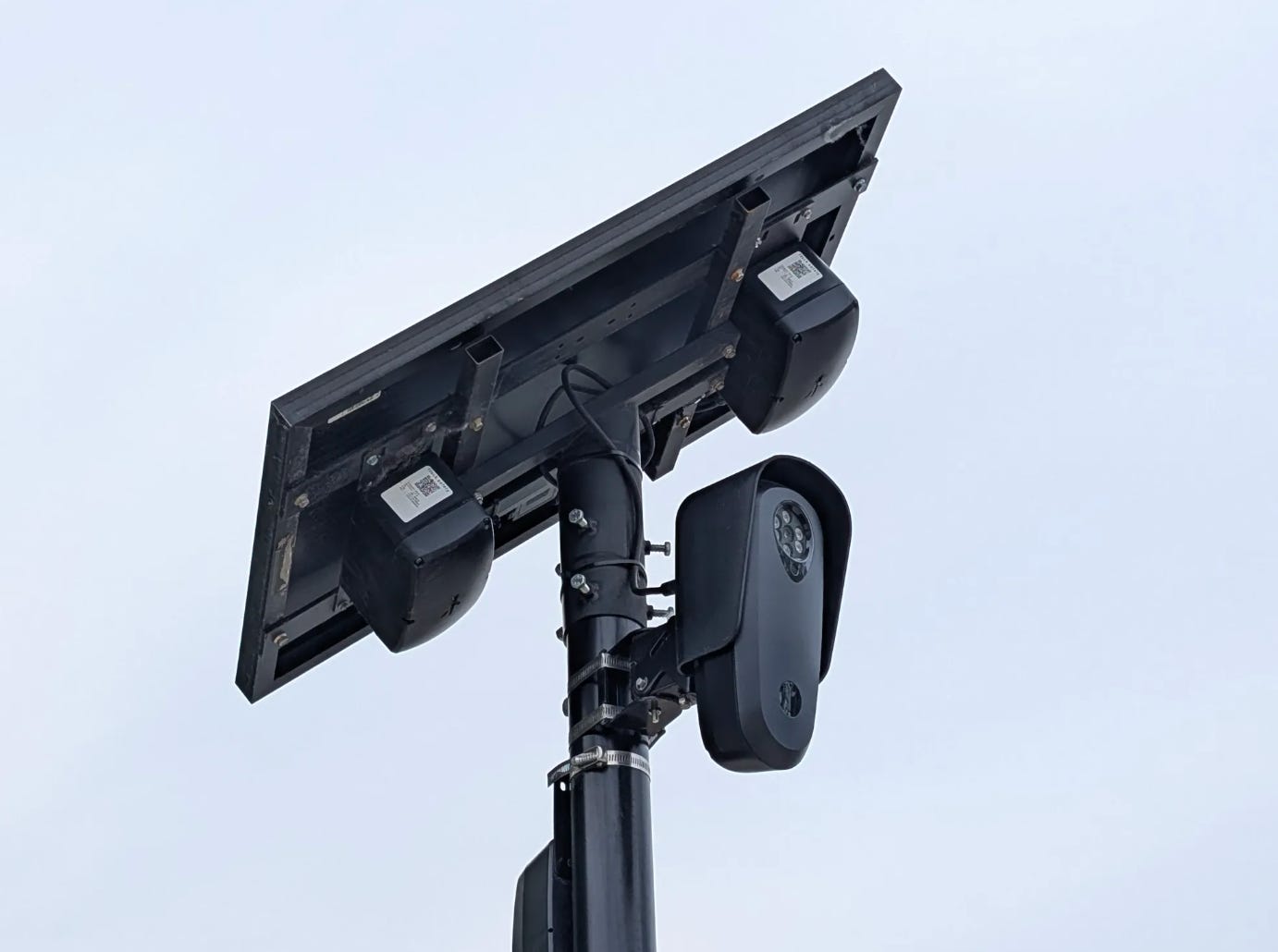
Lafayette mayor says he’s not backing away from support of LPD’s license plate reading cameras: ‘I don’t think public safety and privacy and constitutionality have to be competing values’
A week after Lafayette Mayor Tony Roswarski defended the police department’s use of Flock Safety’s automated license plate readers across the city, against a backdrop of rising calls to get rid of them, he announced he was forming a committee to review policies for the use of technology in city operations.
Roswarski on Thursday appointed a trio of city council members, the city clerk and a member of the Lafayette Civil Service Commission to a newly formed Technology and Privacy Advisory Committee to review current and future systems that collect, store, analyze or share information.
Roswarski said the committee would make regular reports to the Lafayette City Council, starting by early 2027, and audit the use of data collection through the police department or other city operations to see that they square up with privacy and constitutional rights.
“This does not pull back on anything that I said about Flock cameras,” Roswarski, a former captain with the Lafayette Police Department, said. “I don’t think public safety and privacy and constitutionality have to be competing values. I think there is room to do both. That will be a big part of what this committee does with this, making sure that we’re using it properly, that we’re getting the value for our community that we should, and still being cognizant of making sure that we’re doing it right.”
Roswarski has defended the use of Flock Safety cameras – first deployed in 2022 and now numbering 30 along streets and roads in Lafayette – as a key crime-solving tool. He told city council members Aug. 3 he believed recent pushback against the technology was based on some misinformation about how data collected by the cameras was being used the LPD.

Residents have been peppering city council public comment sessions at recent meetings on both sides of the Wabash River with concerns about whether data collected locally by a third party, private company is truly under the cities’ control or whether, as one local petition states, “accumulation of this data can be used for indefinite tracking, creating a climate of fear and oppression instead of one of safety and protection.” They’ve raised concerns that technology designed to capture make, model and plate information from passing cars too easily could be expanded into face recognition, voice recordings and more as technology and police desire grew.
Reports of protesters in other places taking reciprocating saws or duct tape to the roadside cameras have spread.
“We appreciate that there’s not been any vandalism or any property destroyed and that we can all work to have civil discussions about this,” Roswarski said. “I’m hoping that this announcement of the committee shows that I am open to those discussions, and I’m trying to get more information out and making sure there’s extra sets of eyes looking at things.”
The move in Lafayette comes as West Lafayette is working on a review of Flock Safety cameras there. West Lafayette Deputy Chief Dave VanVactor said last week that meetings were being arranged between police, city council members and the city’s IT department with Flock Safety to see whether assurances given when WLPD first installed the license-plate reading technology were still good or needed to be adjusted. VanVactor, who said the city’s four automated license-plate readers have played a big part in solving crimes in West Lafayette, said he hoped to be able to report back to the council in September.
In Lafayette, Roswarski laid out the focus for the new advisory committee, including: how public safety and other technology is being used by the city; the types of investigations, incidents, services or other circumstances in which information collected through these technologies is accessed or utilized; policies on the collection, retention, access, sharing and disposal of information; compliance with applicable federal, state and local laws, city policies and constitutional protections; ways to improve transparency regarding technology; whether additional policies, procedures, reporting requirements or safeguards are appropriate; and how the city should evaluate and oversee new technologies before or as they are implemented.
The committee members will include city council members Lauren Ahlersmeyer, Perry Brown and Steve Snyder, City Clerk Cindy Murray and Eric Rody, a city board of works member and member of the LPD Civil Service Commission. Roswarski said Jacque Chosnek, the city attorney, and Andy Milam, the city’s information technology director, will assist the committee.
Meanwhile, Flock camera systems remain in the headlines across the state and the country. Among the reports:
In Muncie, a pair of men were arrested and charged after a Flock camera near Ball State University was taken down. Muncie Star-Press reporter Douglas Walker’s account included this: “Surveillance video reportedly showed (one man) ‘using a reciprocating saw to cut (down) the Flock camera mounting pole.’” Walker also reported that police used pictures from the Flock device to identify a pickup truck at the scene, leading to the arrests. Here’s more: “Young Muncie men arrested in destruction of Flock camera near BSU.”
The Indianapolis Star reported this week that “an Indianapolis Metropolitan Police officer is under criminal investigation after the department learned he was using automated license plate readers ‘for personal reasons.’” IndyStar reporter Kyle Murphy’s account included that Chief Tonya Terry “declined to comment on the specifics of the misuse but said that the officer had made ‘hundreds’ of searches for only a few license plates.” Read more here: “IMPD officer under investigation after alleged misuse of Flock cameras.”
That dovetails with news from Flock Safety that it would require stricter oversight after a Washington Post investigation found dozens of police officers had misused its cameras to spy on their exes and romantic interests. The Washington Post report included this: “Flock, the maker of a vast roadside camera network that maps cars’ movements into a database searchable by law enforcement, said it would for the first time start requiring officers to label every search with a criminal case number and automatically review all searches for ‘abnormal activity,’ a previously voluntary feature that the company said was used by about a third of its 7,000 law enforcement agencies nationwide.” Read more here: “Flock unveils changes after Post report on police misuse of vast camera network.”
The Indiana Citizen reported this week on Lt. Gov. Micah Beckwith comments that he will push for changes in state laws covering the use of Flock cameras and other automated license plate readers. From a report via Indiana Citizen’s Syndey Byerly: “‘I don’t want to see government get into the business of mass surveillance,’ Beckwith said, citing the Fourth Amendment’s protection against unreasonable searches.” Read more here: “Beckwith says he wants Indiana lawmakers to limit police use of Flock cameras.”
THIS AND THAT/OTHER READS …
LOCAL CREWS HEAD TO FLOOD RESCUES ACROSS THE STATE: The storms that have rattled through the past few days brought some damage but mostly spared Greater Lafayette the flooding and chaos spread across much of the state, from The Region to Muncie to Richmond, among others. The scenes, where upwards of 10 inches fell and caused sustained flooding, have been devastating. On Friday, a crew of 11 first responders from Lafayette Fire Department, the West Lafayette Fire Department and the Tippecanoe County Sheriff’s Office deployed to the Anderson area, 85 miles from here, to support water rescue and evacuation operations being led by the State Emergency Operations Center, after Gov. Mike Braun declared a statewide emergency. According to Lafayette Fire Department, the local crew is expected to be there for 24 to 36 hours.


SO LONG TO ALICE’S DEATH BLOOM: The storms this week did take a toll locally, with high winds spelling the end of the towering, death bloom run of Alice, the Agave americana at Purdue’s Botany and Plant Pathology’s teaching greenhouse on the south campus. After poking through to roof of the greenhouse for months as it bloomed for the only time in its life, a thunderstorm snapped the giant flower stalk. (The gasp in the video capturing the moment said it all.) For more about the plant, how it got so tall, how you can still visit and what’s next, Purdue has this: “The death bloom of a century plant.”

KLONDIKE TEACHER ONE OF 10 FINALISTS FOR INDIANA TEACHER OF THE YEAR: Andrea Bornino, a Klondike Elementary physical education teacher, was named among 10 finalists for Indiana Teacher of the Year for 2027, Tippecanoe School Corp. announced this week. Bornino, who has been teaching for 19 years, was TSC’s elementary teacher of the year, which sent her up to be considered for the annual statewide honor from the Indiana Department of Education.