

Support for this edition comes from Entrepreneurship Through Acquisition (ETA), helping Greater Lafayette businesses successfully transition to their next generation of ownership. Through two program tracks, ETA helps aspiring business owners explore the purchase of an existing business while helping current owners plan thoughtfully for an eventual transition. Participants gain practical education, resources, and connections to help them make informed decisions about what comes next. ETA is a collaboration between Greater Lafayette Commerce, MatchBOX Coworking Studio, and the Indiana Economic Development Corporation. Learn more about the program and October 14 kickoff sessions at https://mbxax.studio/upcomingcohorts

WLPD CHIEF DEFENDS DEPLOYMENT OF FLOCK CAMERAS TO SKEPTICAL STANDING ROOM CROWD
The West Lafayette police chief faced a skeptical, standing-room-only crowd Tuesday night at city hall, as he reviewed the city’s use automated license plate reader system, contracted through Flock Safety, in the face of growing calls to ditch the cameras.
WLPD Chief Adam Ferguson spent an hour making a case that the system, first installed in 2022 and now set up to include four automated license plate readers, has been an invaluable investigative tool for the police department.
Ferguson understood, he said, simmering concerns that have played out lately, not only locally but nationally, and that the police department was working to be as transparent as possible about how the Flock cameras were being used – and not being used.
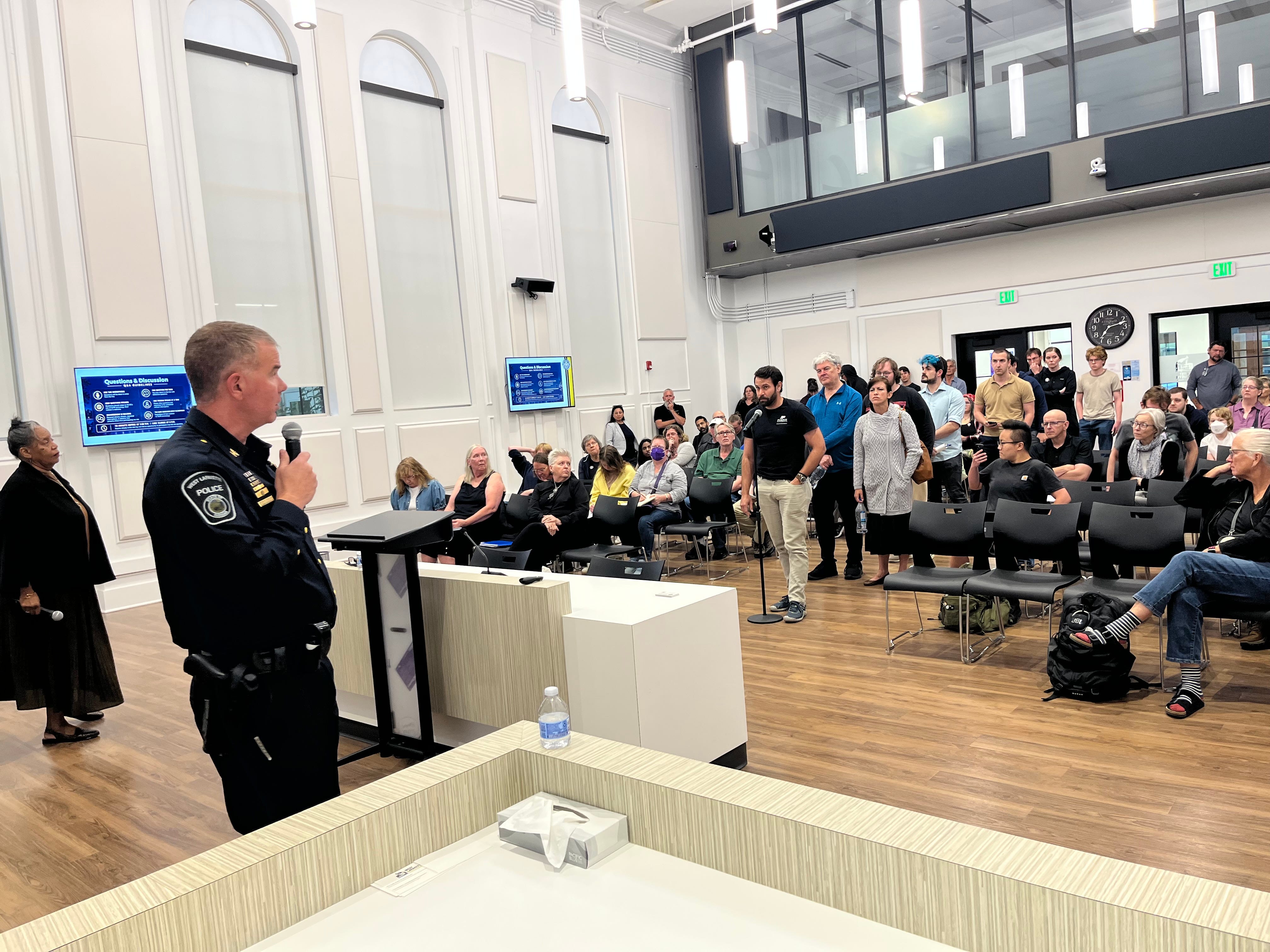
“All I can tell you is that we’re deploying our systems with purpose and hope that you understand that we’re not using these systems against you,” Ferguson said. “Guilt shall not escape. Innocence shall not suffer.”
But in the hour of questions that followed, Ferguson was asked several different ways: Is it really worth it?
And, as one put it: At what point does tracking everyone to catch a few stop being standardized policing and start being normalized mass surveillance?
Several times, Ferguson and city officials were challenged to – if not getting rid of the cameras, altogether – at least shut them off until West Lafayette could get a better grasp on information the Flock system was capable of gathering and determine whether it was being collected in the police department’s name to allow a third-party business to use or sell local data in unsuspecting or nefarious ways.
When Ferguson said he would admit he wasn’t an IT expert, as audience members challenged him to monitor how other communities had canceled contracts and to watch batches of YouTube breakdowns of Flock cameras being reverse engineered to show what the devices were capable of collecting, they said that was what had them uneasy.
“I think the most concerning part of all of this is that I feel like you are just repeating what you have been sold, and what you have been sold is a blatant lie,” Cameron Couts, a Lafayette resident, told Ferguson.
“They do not have our best intentions at heart like you do,” Couts said. “I can tell you have great intentions with all of this. The data that they are collecting is not the same that they are selling you, and it’s putting all of us at risk because they can then sell that data. So, I’m going to ask you to do a full review of Flock, and I mean really, really get down to the nitty gritty. What’s the data? Where’s it going? What are you guys really doing with it? … Please ask those questions and be as hard on them as we are on you tonight.”
Ferguson’s presentation Tuesday night was an expanded version of one he offered to the city council earlier in the month. A Flock representative had been expected to be there but canceled a day before, when the city found out the staffer was no longer with the company, according to the chief.
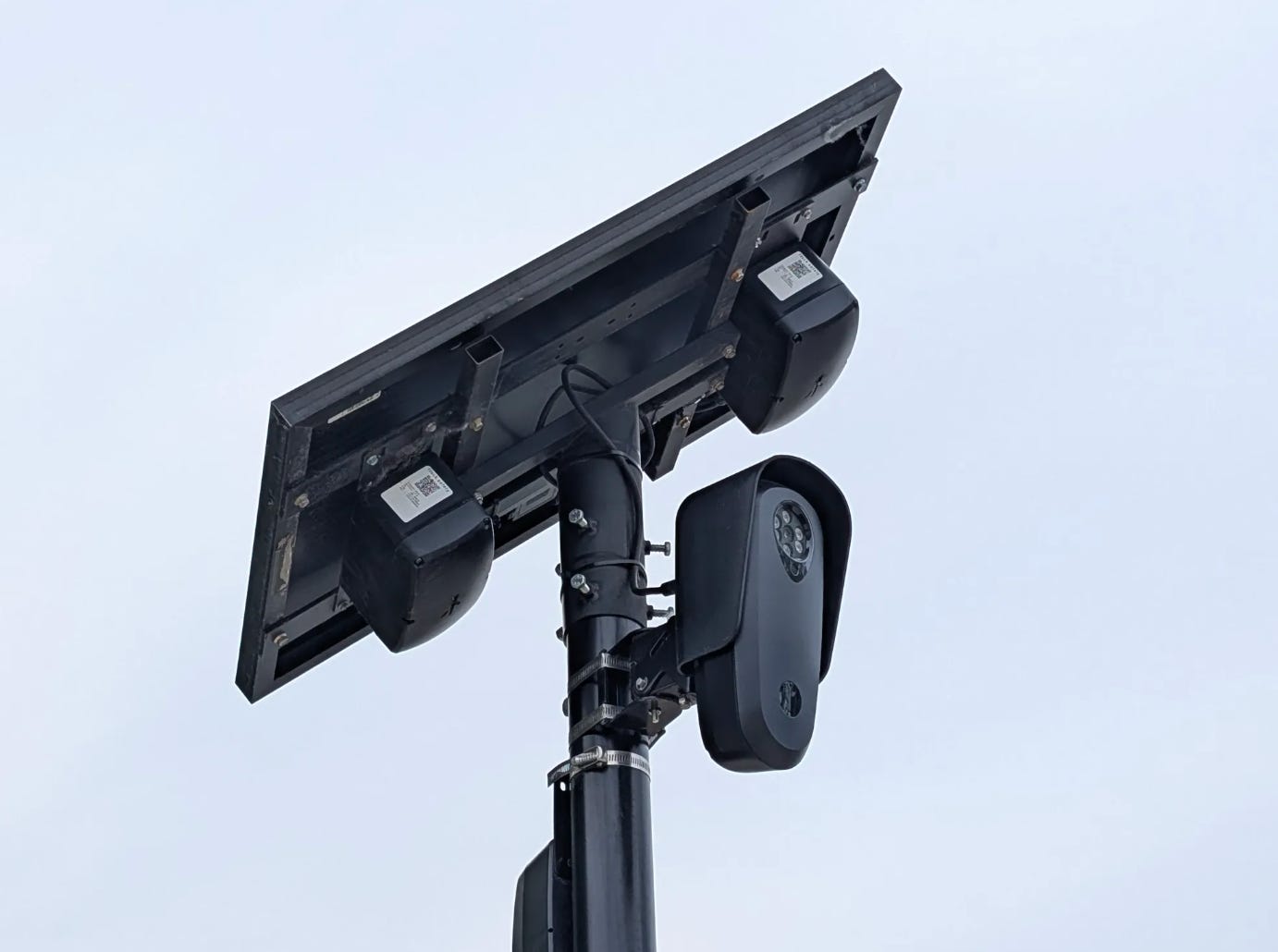
West Lafayette has three operating cameras installed through a contract with Flock, including at Sagamore Parkway near Cumberland Avenue; one looking toward Harrison Bridge and traffic coming into West Lafayette; and one on State Street checking traffic coming into the city from downtown Lafayette. The city had another on Sagamore Parkway near Soldiers Home Road which has been out of commission since it was vandalized in August.
The city also has an automated license plate reader system for its parking enforcement and a separate system in patrol cars. Ferguson said those three systems and the data they collect are not connected.
The Flock cameras are considered fixed-point systems, snapping pictures of license plates numbers, along with make and model and rear-facing images of vehicles, and the date and time – as Ferguson put it, “at one location and one point in time.” Ferguson said the cameras are not set up to gather audio, automatic registration information from the Bureau of Motor Vehicles, facial recognition of drivers or cell phone data of occupants.
Before West Lafayette installed its automated license-plate recognition cameras in 2022, the city council imposed rules that limited how police could use the technology, limited expansion and dictated 30 days as a maximum time data collected could be kept.
Ferguson said Tuesday that WLPD keeps data for seven days for routine access, and up to 30 days for restricted recovery. After 30 days, the data is deleted, unless preserved as evidence in a specific case or required by law, Ferguson said.
West Lafayette is part of a shared local network of Flock cameras in West Lafayette that includes six for the Purdue Police Department; two for the Tippecanoe County Sheriff’s Office; and eight for The Launch, a private apartment complex in West Lafayette. Ferguson said local police agencies also share information from roughly 20 contracted by the Lafayette Police Department and other private businesses that have provided permission.
Ferguson said WLPD uses Flock information when the system sends an alert about a plate or vehicle that may correspond with a case and in searches when investigating a reported crime, a missing or wanted person, stolen vehicle or a known suspect vehicle. Ferguson said the alerts are leads, not probable cause, and demand verification and follow-up for corroborating evidence in a case.
Ferguson said that since 2022, the automated license plate reader system had contributed to 301 cases, including 48 arrests, 24 warrants served, 14 stolen vehicles or plates recovered, and 12 hit-and-run investigations.
Leading up to Tuesday’s presentation, Ferguson checked data on his personal vehicle over the course of 30 days, coming up with 50 observations by the Flock compared with 173 trips he personally logged. In that time, he said, the system had a gap at one point of nearly 10 days when his vehicle didn’t show up in Flock data. And in that time, he said, 140 of his trips – or nearly 81% – weren’t detected by Flock.
“I was observed going to Rotary – it doesn’t know that I was in Rotary,” Ferguson said. “It observed me going on a few occasions to my church. It doesn’t know where my church is, doesn’t know which church I’m affiliated with. … A comprehensive look, giving myself to AI using ALPR data, captured moments in time, not a comprehensive picture of who I am or where I was going.”
During an hour of questions that followed, no one spoke up in favor of keeping the technology on West Lafayette roads.
Among the questions and concerns:
What would WLPD do to guarantee that federal agencies, including Immigraton and Customs Enforcement, weren’t tapping into West Lafayette data via Flock – despite assurances that the city hadn’t opted into sharing that information?
What assurances would the community have that additional features, beyond license plate readers, would be added later?
And what assurances were there that West Lafayette police – and officers with other local agencies – were using the data properly, given the number of cases coming to light in other communities where officers were accused of using Flock cameras to stalk people?
“Who is auditing the police?” Joshua Bustamante asked. “I don’t believe it should be the police’s job to say, ‘Trust me, bro, we’re doing our jobs.’”
Ferguson said internal audits of Flock searches were being done and that violations would lead to discipline or termination.
“I am in favor of professional safeguards and responsible ALPR use,” Ferguson said. “I can’t stand up here, won’t stand up here, and tell you that there’s not a risk that somebody could misuse the system. I’m saying that we will address that appropriately if we believe that it happens. … ALPR systems have legitimate public safety value, but I believe that we can use those systems responsibly, transparently and within appropriate limits to balance the needs of the community with public safety.”
Lafayette police have faced similar questions about Flock cameras. Lafayette Mayor Tony Roswarski, who told city council members there in August that he backed LPD’s use of the technology, announced last month that he was setting up an internal technology review panel to address questions about a number of AI-related issues.


Ferguson said he was open to that sort of approach in West Lafayette, too.
Questions surfaced Tuesday evening about a database assembled by USA Today that tracked use of Flock cameras, based on records requests of agencies across the country. Ferguson said his agency was still trying to figure out how that included West Lafayette use of Flock amid some 78 million searches documented.
“We did ask some questions about where that came from, and essentially through some contractual loophole with another agency that enjoyed sharing access with everybody, they were able to get the data in the form that it shows with USA Today,” Ferguson said. “Those things have since been changed. Our concern was how did our data, West Lafayette data, get on USA Today without our permission?”
The rumbling in the crowd amounted to: That’s the point. How can the city protect local data if it’s left in the hands of a private company and subject to contractual loopholes?
“You’ve got to shut it down,” Couts said.
Several West Lafayette City Council members were in the crowd Tuesday night. So was Mayor Erin Easter.
“I think our police have deployed the technology properly, and I trust the West Lafayette Police Department with the work they do and the care they take,” Easter said. “I think Chief Ferguson is committed to following up with questions tonight and being transparent.”
As for the terms of Flock’s contract and the city’s resolution overseeing use of automated license plate readers, Easter said: “I think there’s an opportunity to review things.”
More questions
City officials offered note cards during Tuesday night’s session for more questions about West Lafayette’s use of automated license plate readers. Ferguson said he would post answers by Oct. 2 here: www.westlafayette.in.gov/government/police-department/crime-and-safety/flock-safety.
Here are the slides from Chief Adam Ferguson’s presentation

Watch the session here

IN RELATED NEWS
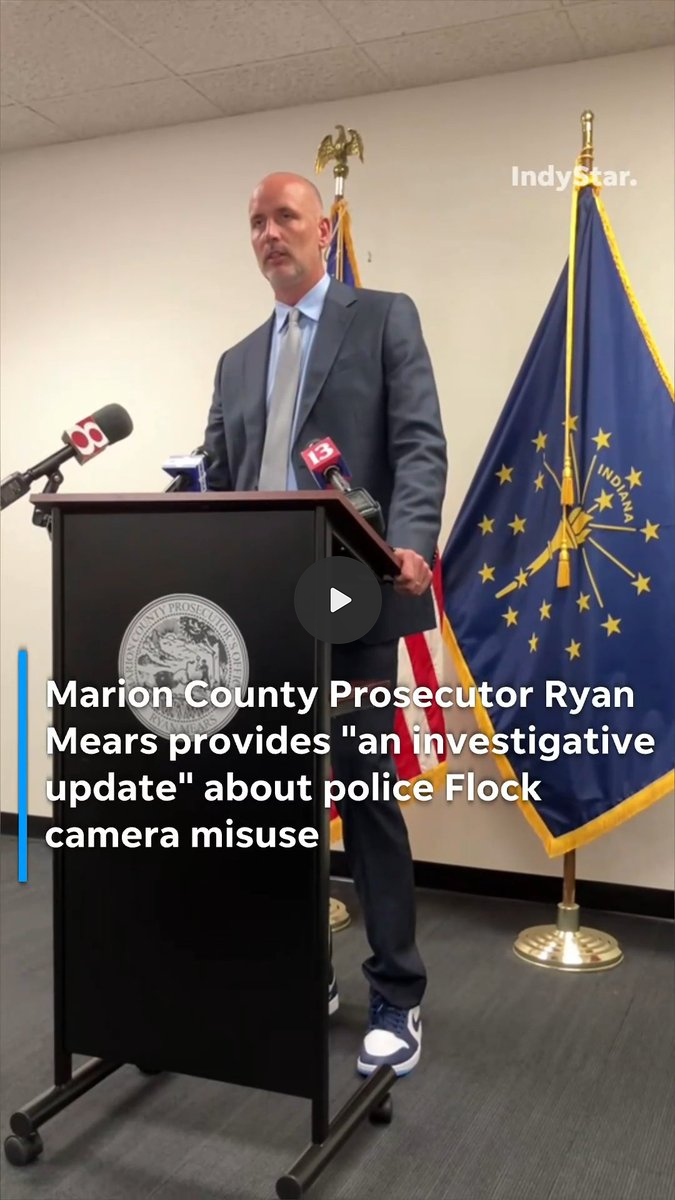
INDIANAPOLIS OFFICERS CHARGED IN ALLEGED FLOCK CAMERA ABUSE: Five Indianapolis police officers were charged Wednesday with fraud and misconduct after being accused of misusing automated license plate reader technology after internal IMPD audits from August and September. Prosecutor Ryan Mears said Wednesday, when announcing the charges: “This is definitely just the beginning. … The message I’d have today is this is just the initial review.” WTHR had this report: “5 current, former IMPD officers charged for alleged misuse of Flock license plate reader technology.”

The following story was published this week by Free Press Indiana. It’s used by permission here:
Indiana sees surge of cities, counties ending Flock camera contracts
By Carson Gerber / Free Press Indiana
A growing number of Indiana cities and counties are doing away with license plate reading cameras after fierce pushback from local residents saying the devices violate their constitutional rights.
In just the last 30 days, officials in Fort Wayne, Chesterton and Marshall, Starke, Kosciusko and Noble counties have voted to cancel or not renew contracts with Flock Safety, the nation’s largest provider of the devices.
Those communities join Bloomington and Monroe County, which were among the first in the state to cut ties with the company due to residents’ concerns that the devices amount to an illegal search and seizure.
The cameras take photos of vehicles and their license plates as they pass by. The photos are added to a searchable network used by law enforcement agencies. Police argue the cameras provide automated, real-time vehicle data that significantly speeds up criminal investigations and helps locate missing persons.
In Indiana, there are more than 3,700 automated license plate readers, including at least 2,930 documented Flock Safety cameras, according to crowdsourced tracking data from the nonprofit Eyes Off Indiana, which calls for more regulations of the cameras.
That ranks the state ninth in the nation for the total number of cameras.
Backlash grows
Walker Lasbury, president of Eyes Off Indiana, said the devices have created a rare “unicorn” issue drawing opposition from both conservative groups like Americans for Prosperity and left-of-center organizations like the American Civil Liberties Union.
Both organizations have recently launched campaigns in the state to raise grassroots support for banning or regulating the systems, contributing to the growing backlash, he said.
“It seems like everyone’s starting to take notice of this issue, and they’re starting to bring the issue to their local elected representatives,” Lasbury said.
Fort Wayne council members said they voted to end their contract for 36 Flock cameras after an “overwhelming” number of residents reached out opposing them.
In Kosciusko County, the council voted on Sept. 10 to end its contract after hours of public comment in opposition.
Resident Greg Henderson told the council the cameras represented government overreach and pointed to instances in which officers used incorrect data provided by the devices to arrest or detain innocent people.
“My point is that these systems aren’t infallible,” he said. “They’re not inerrant.”
Indiana has no laws regulating the cameras. Lasbury said he supports the cities and counties that have ended contracts with Flock, but argued state lawmakers need to take action to protect every person.
“When you’re traveling from county to county, your privacy protections shouldn’t change,” he said. “For that reason, it’s the job of the state to enact regulation that protects Hoosiers, no matter what county or city you’re in.”
A growing number of lawmakers are expressing concern.
Republican U.S. Rep. Marlin Stutzman (IN-3) said he is collaborating on federal legislation to restrict or eliminate government use of Flock-style surveillance networks on public roads.
“We don’t want to be Russia,” he told 21Alive News on Wednesday. “We don’t want to be a communist country where the government can watch our every move.”
‘Help solve crimes’
But other cities are doubling down on using the cameras.
Muncie Mayor Dan Ridenour said he fully supports Flock cameras for the “positive results it has provided.” He said officers are required to take special training to use the system to reduce misuse.
“All we want to do is to help solve crimes,” Ridenour said in a video posted to Facebook.
In Michigan City, the police department is asking the city council for $300,000 to install seven more swivel cameras and buy a portable Flock Safety Trailer and a new drone. Assistant Chief Kyle Shiparski promised city council members additional safeguards if the money is approved.
“The goal is legitimate access when officers need it, documentation when they use it and accountability afterwards,” Shiparski told the council Tuesday.
In Fort Wayne, after the council voted to end its Flock contract, the police department said in a statement that the devices had “proven to be a valuable investigative resource for our officers and detectives.”
“The department continues to believe it can be used responsibly while maintaining appropriate safeguards for privacy, accountability, and oversight,” the release said.
Thanks, again, for support for this edition from Entrepreneurship Through Acquisition (ETA), helping Greater Lafayette businesses successfully transition to their next generation of ownership. ETA is a collaboration between Greater Lafayette Commerce, MatchBOX Coworking Studio, and the Indiana Economic Development Corporation. Learn more about the program and Oct. 14 kickoff sessions at https://mbxax.studio/upcomingcohorts
Thank you for supporting Based in Lafayette, an independent, local reporting project. Free and full-ride subscription options are ready for you here.
Tips, story ideas? I’m at davebangert1@gmail.com.
Thanks, Dave. Nice article with some great supplements. I look forward to reading those.
It was a good meeting. I'm glad that everyone came out.
The first order of business is transparency. One initial action item is for the WLPD to share their contract with Flock (and any other similar vendors) so the public can review what type of agreement the City is entering into on behalf of the Public.
Another one would be to release the current policies that govern all of the technology systems that are in place and utilized by WLPD. I am sure there are systems we are unaware of.
From there, we can study and ask more questions, resulting in legislative action from the City Council. They were there, as you reported, so they know that ask is coming.
---
Quick question: It wasn't clear to me in the text, but I assume this was Mayor Easter's quote?
“I think our police have deployed the technology properly, and I trust the West Lafayette Police Department with the work they do and the care they take. … I think Chief Ferguson is committed to following up with questions tonight and being transparent.”
To that I would say, "Sure. But let's verify that trust."