

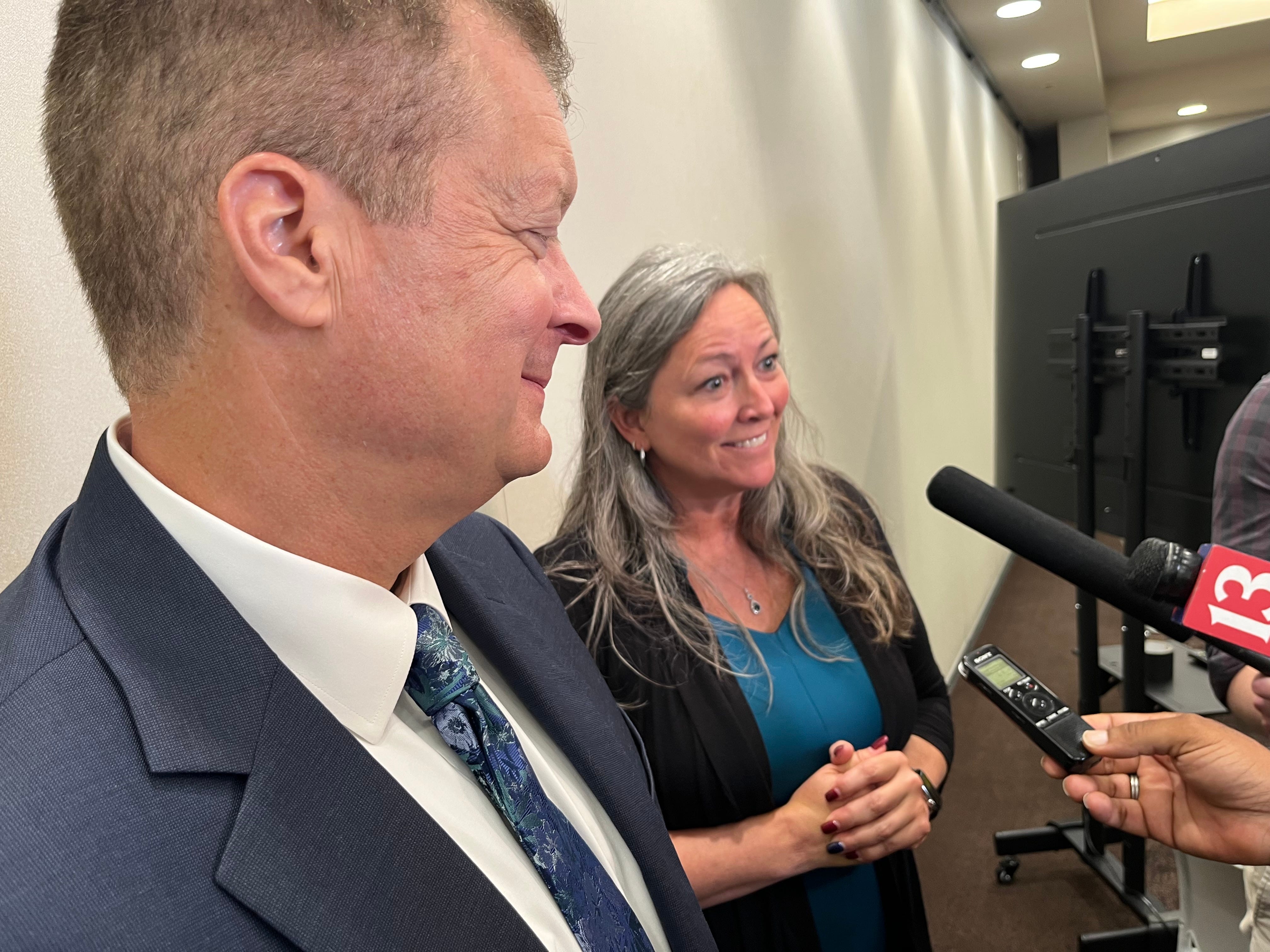
Attorneys for Paula Copenhaver argued in a filing Friday afternoon that the Indiana Supreme Court should not take up state Sen. Spencer Deery’s appeal of Indiana Recount Commission decisions that tossed enough votes in the Senate District 23 Republican primary to turn his three-vote victory into a three-vote victory for Copenhaver.
Copenhaver’s response didn’t focus on questions Deery raised with the Court of Appeals earlier this week about whether the Recount Commission’s decisions Aug. 10 were “arbitrary and capricious,” putting clerical errors on the part of election officials in three of District 23’s counties over the intention of voters.
Instead, Bill Bock, an Indianapolis-based attorney who led Copenhaver’s recount and election challenge, argued that Deery’s attempt to hold off putting Copenhaver’s name on general election ballots and overturning the election – yet again – was moot because it came too late to fit in with state-mandated deadlines counties depend on to get ready for the November election.
Specifically, Bock pointed to an Aug. 21 deadline the Indiana Election Division has to certify candidate listings.
“The reasons this Court respects legislatively established election deadlines are both constitutional separation of powers (the Legislature, not the courts, is charged with setting election procedures and deadlines) and ensuring free and equal elections,” Copenhaver’s response to Deery’s appeal argued. “Respect for the Legislature’s carefully chosen deadlines ensures that elections are conducted in a uniform and equal manner, avoiding chaos that could arise from ad hoc or judicially established election deadlines.”
Bock argued that just because Deery didn’t agree with Indiana Recount Commission decisions to wipe out some votes cast in the May 5 primary, that didn’t justify messing with a traditional campaign cycle envisioned in schedules set in law by the General Assembly. Elections, Bock argued, must end sometime – and Deery’s time is up.
Bock wrote:
“In this case, were the certification deadline disregarded, Republican voters would have less time to coalesce around their candidate and promote that nominee in comparison to the Democratic and Independent Party nominees. As for the Democrat and Independent candidates, they likewise could be disadvantaged by having less time to focus their advertising on the Republican nominee. The public, in turn, would have a shortened period within which to evaluate the candidates and make an informed choice. These are reasonable considerations and are by no means the only interests that may have led the General Assembly to adopt the certification deadline. There is no legitimate basis for disregarding the Legislature’s decision on this point and substituting the judgment of a court, candidate, or other person as to the amount of time that should exist between candidate certification and the general election.”
Along with his request filed Aug. 17 asking the Indiana Supreme Court to accept transfer of the case – and in and expediate fashion – Deery’s attorneys also requested a stay that would delay ballot preparation.
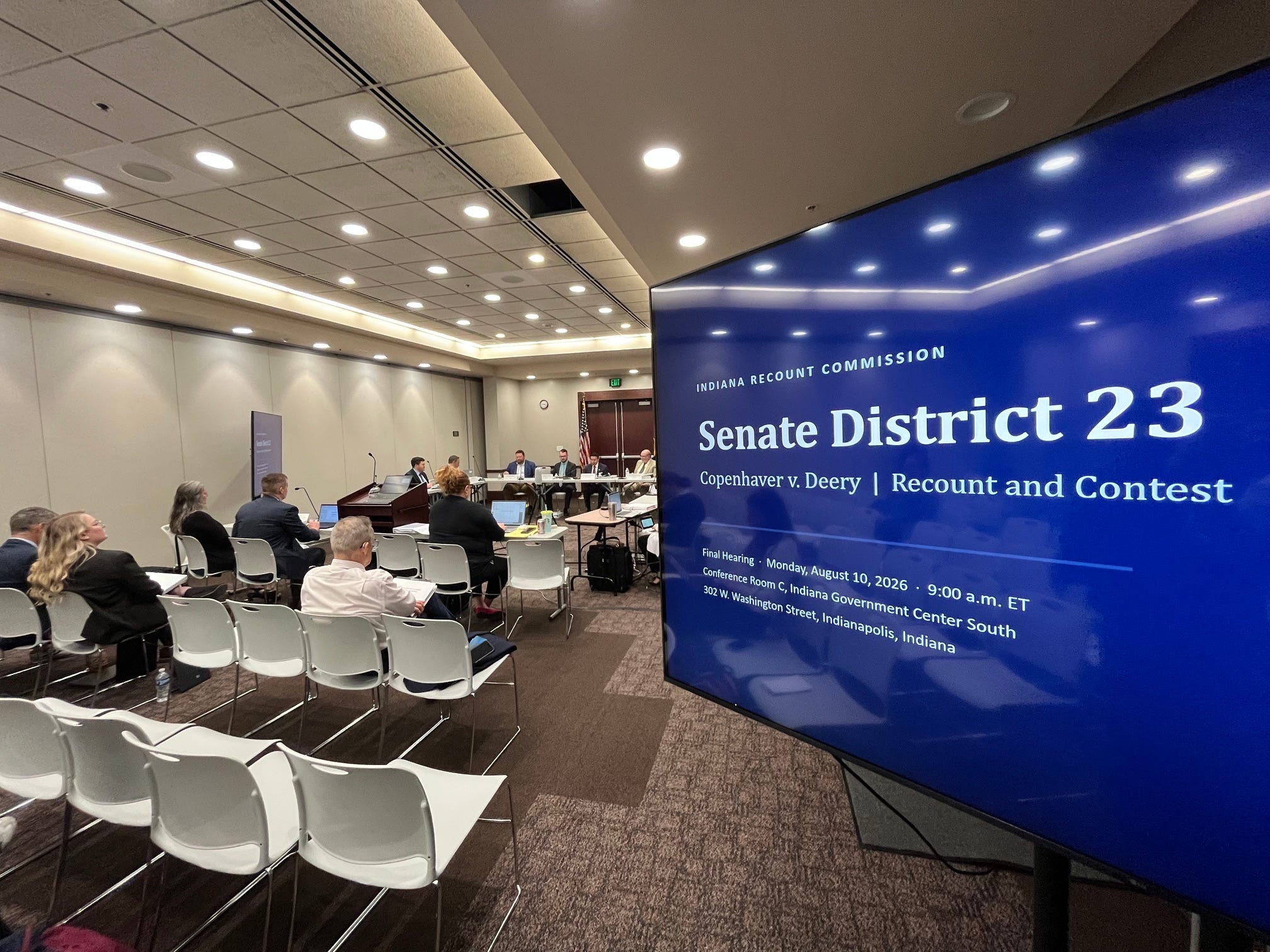
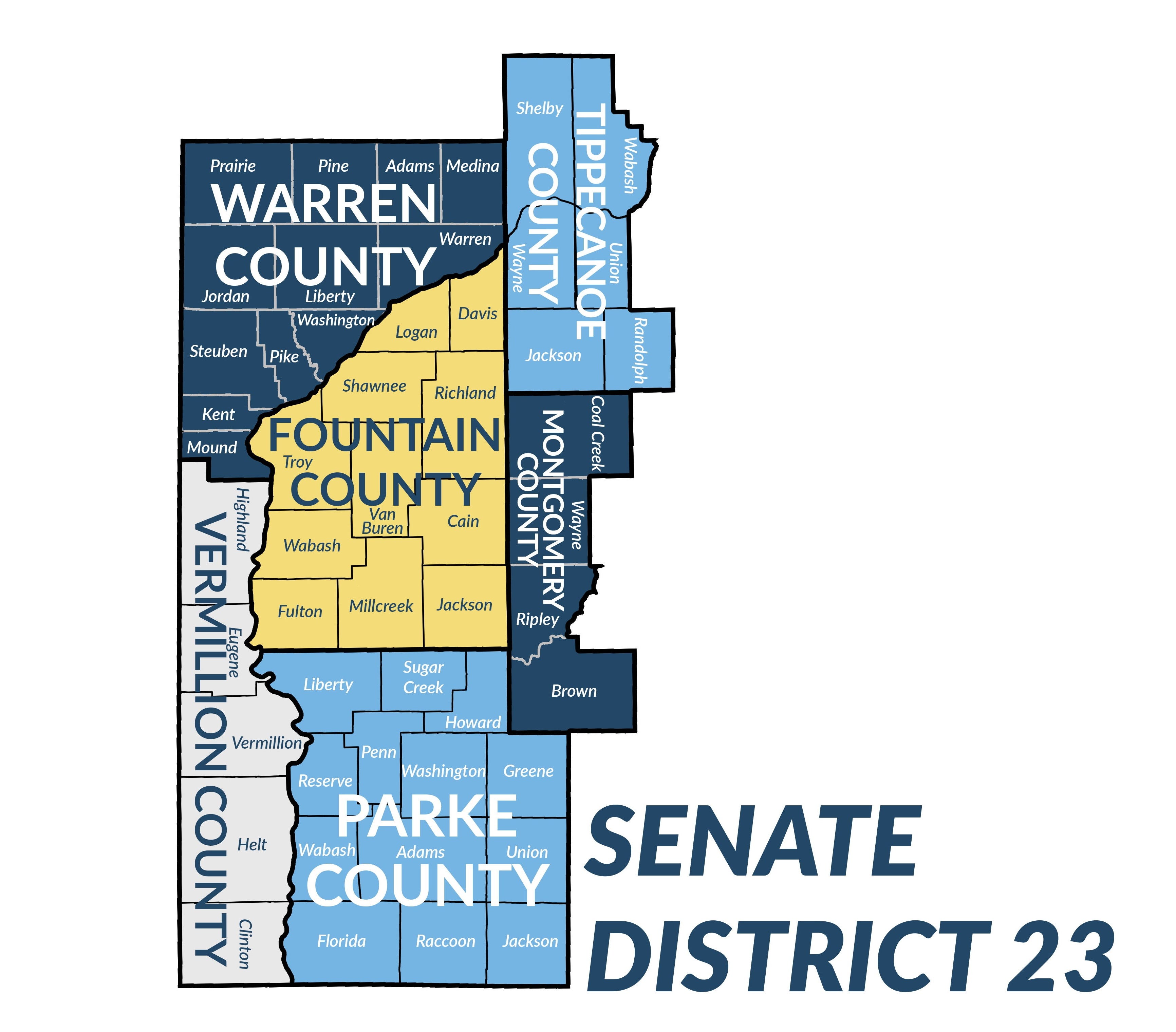
Deery’s motion to go directly to the Supreme Court, rather than first going to the Indiana Court of Appeals, acknowledged the compressed timeframe facing election officials in Tippecanoe, Warren, Fountain, Montgomery, Vermillion and Parke counties, where ballot prep includes mid-September deliveries of absentee ballots to voters and the start of early voting Oct. 6.

As of Friday afternoon, the court had not issued a ruling on the stay, according to online court records.
In an order signed by Chief Justice Loretta Rush earlier in the week, the justices gave both sides deadlines for responses. Deery is scheduled to file a final response Monday, Aug. 24. The justices indicated they would take those under advisement.
No hearing date had been set, as of Friday.
During an Aug. 10 hearing in Indianapolis, Copenhaver’s team successfully persuaded the three-member Indiana Recount Commission to reject enough votes for Deery to swing the Republican primary and declare Copenhaver, a former Fountain County clerk, the winner.
Bock that day pointed to mistakes in how ballots were handled – whether they had required poll worker initials, or whether a county clerk stamped a seal or signature on a ballot. Deery’s camp argued during the hearing that the tactic threatened to take away votes people cast in good conscience.
The Recount Commission that day rejected 10 votes in the Senate District 23 race. Those included eight for Deery and two for Copenhaver over a combination of missing statutorily required reliability indicators, including the initials of two members of a county’s absentee voter board, the county clerk’s stamped signature and the county clerk’s official seal.
That put the final count in the May 5 primary at 6,332-6,329 for Copenhaver.
Deery’s appeal focused on six of those 10 ballots, all of which had been cast for him.
Those ballots – two each in Montgomery, Vermillion and Warren counties – lacked the seal and signature of the county clerk.

Deery and Copenhaver each lost two votes because absentee ballots being challenged didn’t include the required initials of two members of a county’s absentee voter board. The Indiana Recount Commission voted 3-0 in each of those situations, agreeing that state law gave no leeway and that the votes must be rejected.
Deery’s appeal did not challenge decisions on those four ballots.
The other six for Deery were missing either the clerk’s signature or the clerk’s seal.
Michael Claytor, a Democratic member of the Recount Commission, made a case during the Aug. 10 hearing that the commission had discretion under the law to accept those ballots. In each case, Secretary of State Diego Morales and Republican commission member Paul Mullin voted to reject the ballots, after Bock argued “that Indiana requires high standards to protect the integrity of absentee ballots because absentee ballots are more susceptible to fraud and potential manipulation.”
Those 2-1 votes by the Indiana Recount Commission on those six ballots became the difference in the race.
Deery’s attorneys – Karen Celestino-Horseman, Samantha DeWester and William Groth – argued that the Indiana Recount Commission’s decisions were reversable errors that had disregarded “undisputed intent of those voters to nominate Sen. Deery … through no fault of their own.”
The appeal points to a “savings clause intended to protect against clerk errors such as the omission of the seal/signature, while expressly stating that absentee ballots lacking initials cannot be counties in a recount.”
The appeal points to a provision in Indiana Code that says that a ballot cast by a voter in compliance with state law, other than “the act or failure to act of an election officer,” may be counted in a recount, “unless evidence of fraud, tampering or misconduct affecting the integrity of the ballot is presented by a party to the proceeding.”
During Recount Commission hearings, Copenhaver’s team did not suggest the voters were involved in fraud of misconduct. Bock argued, though, that it was a matter election integrity.
The appeal cites Brown v. Grzeskowiak, a 1959 Indiana Supreme Court ruling that concluded “in the absence of fraud, actual or suggested, statutes will be liberally construed to accomplish this purpose (of the free and fair casting and counting of ballots), so as to uphold the will of the voters and ‘prevent disenfranchisement.’”
The appeal argues that the 2-1 votes on ballots that contained questions about clerk’s signatures and seals leaned on “unbridled discretion” that was “standardless.”
“Such unbridled discretion power would be arbitrary and capricious,” the filing argues.
The appeal argues: “In applying the savings clause, the Commission should have first determined 1) whether the ballot was properly cast by the voter; and 2) whether the problem with the ballot is due to an error of an election official; and 3) whether the challenger satisfied the heavy burden of showing evidence of fraud, tampering or misconduct affecting the integrity of the ballot. If the answer to the first two questions is ‘yes’ and as the Commission found no evidence of fraud, tampering, or misconduct as no evidence of such was presented, the six ballots should not have been subtracted from Deery’s total votes received. Two members of the three-member Commission voted not to count the six ballots without providing any explanation.”
As of now, Copenhaver would be on the Senate District 23 ballot with David Sanders, a Democratic member of the West Lafayette City Council, and independent candidate Joshua Brant.
Clerks in three of Indiana Senate District 23’s six counties said Friday they were watching what happens with Deery’s appeal before taking the next steps.
“Our ballots are all proofed and ready to go,” Fountain County Clerk Patty Smith said Friday afternoon. “We are waiting to see the Supreme Court’s final outcome next week before we sign off on them.”
Tippecanoe County Clerk Julie Roush said the state certification of candidates was in hand this week, though the county’s election office would begin creating ballots next week. Montgomery County Clerk Sondra Sixberry said her office had time in the schedule to see how the appeal played out.
“Hopefully, they’ll give us some kind of deadline, and then we’ll probably try to hold off on printing things until we have to,” Sixberry said Friday. “We are all kind of on alert that when we get a notice that something may change, we may have to change that particular line item.”
Barring a successful appeal, Deery would be the sixth of seven state Senate incumbents targeted by Trump who lost in the May 5 primary, after facing attack campaigns that ran into the millions of dollars. Trump and White House allies went all in to get revenge against Indiana Senate incumbents who did not back a push to redraw Indiana’s congressional maps to boost Republican chances to pick up seats in the U.S. House. Deery had been particularly outspoken in his opposition to mid-decade redistricting.
Through that, Copenhaver picked up a Trump endorsement in the primary. Last week, she offered thanks to Trump, along with U.S. Sen. Jim Banks, Gov. Mike Braun and Lt. Gov. Micah Beckwith, who is her boss and was active in recruiting her to run as things went sour on the redistricting plan.
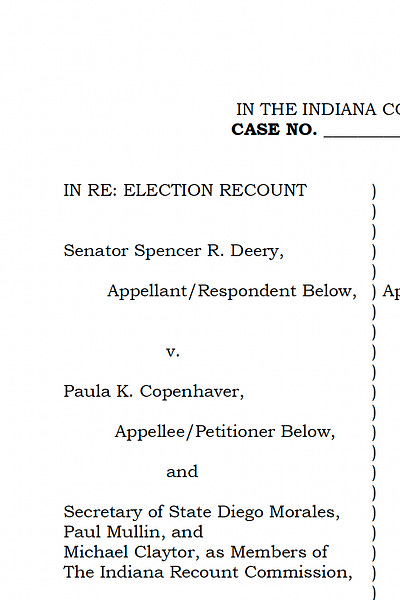
The filings
For more coverage


Thank you for supporting Based in Lafayette, an independent, local reporting project. Free and full-ride subscription options are ready for you here.
Tips, story ideas? I’m at davebangert1@gmail.com.
So, will disaffected, and frankly robbed Spencer Deery supporters still vote for Trump-backed Copenhaver? There surely is an alternative--a candidate who has been speaking about the REAL issues facing citizens in Senate District 23. Isn't this a time for bi-partisan rejection of Trump money and Trump lawyers into Senate District 23? isn't this time for fair-minded Hoosier voters to consider voting for the Democratic candidate? West Lafayette City Councilor David Sanders. He comes with no 'strings attached". Can one truly say that about Copenhaver?
With apologies, I don't really care about the Deery/Copenhaver outcome. What I care about are those few voters who have been told their votes don't count because of minor clerical errors. So, it would be fair to void the Recount Commission's decisions if there were any typos or grammar errors in their filings. But again, the outcome will have no impact on Indiana law making as far as I can tell.