


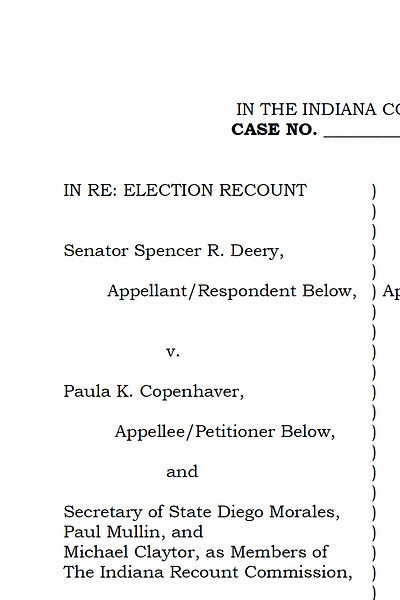
State Sen. Spencer Deery, who saw a three-vote victory in the Senate District 23 Republican primary turn into a three-vote loss last week over a series of votes rejected on technical issues, on Monday filed a request for an emergency transfer to the Indiana Supreme Court to consider his appeal, arguing that the Indiana Recount Commission decision was “unbridled … arbitrary and capricious.”
“The error of the Commission overturned an election and disregarded the voice of the voters who have a fundamental right to vote in free and fair elections and to have their vote counted,” an appeal filed by Deery’s attorneys Monday afternoon argued.
In filings Monday afternoon, Deery’s attorneys also asked for a stay that would prevent election officials from placing Paula Copenhaver’s name on November general election ballots as the Republican nominee in the six counties that make up Indiana Senate District 23.
Those ballots face a Friday, Aug. 21, deadline to certify ballots across the state.
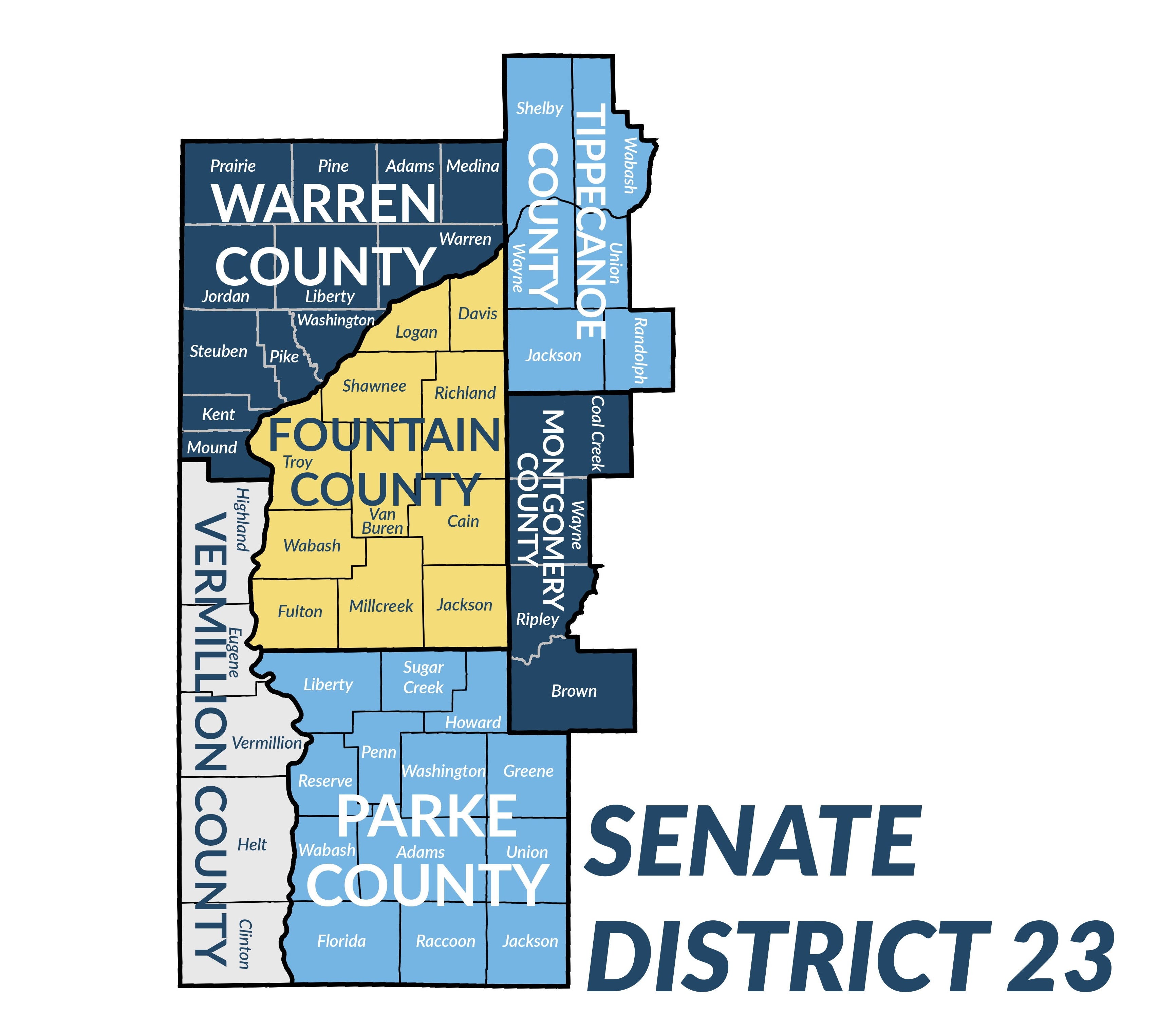
Deery’s motion to go directly to the Supreme Court, rather than first going to the Indiana Court of Appeals, acknowledged the compressed timeframe facing election officials in Tippecanoe, Warren, Fountain, Montgomery, Vermillion and Parke counties, where ballot prep includes mid-September deliveries of absentee ballots and the start of early voting Oct. 6.
“Without staying of the certification or enjoining the clerks from preparing ballots identifying the candidate for Senate District 23, Sen. Deery will suffer irreparable harm and without meaningful review, he will have an inadequate remedy at law,” the motion read.
Attorneys for Copenhaver, a former Fountain County clerk, were not immediately available for comment Monday.
But on Aug. 10, they successfully persuaded the three-member Indiana Recount Commission to wipe out enough votes for Deery to swing a three-vote loss into a three-vote victory.
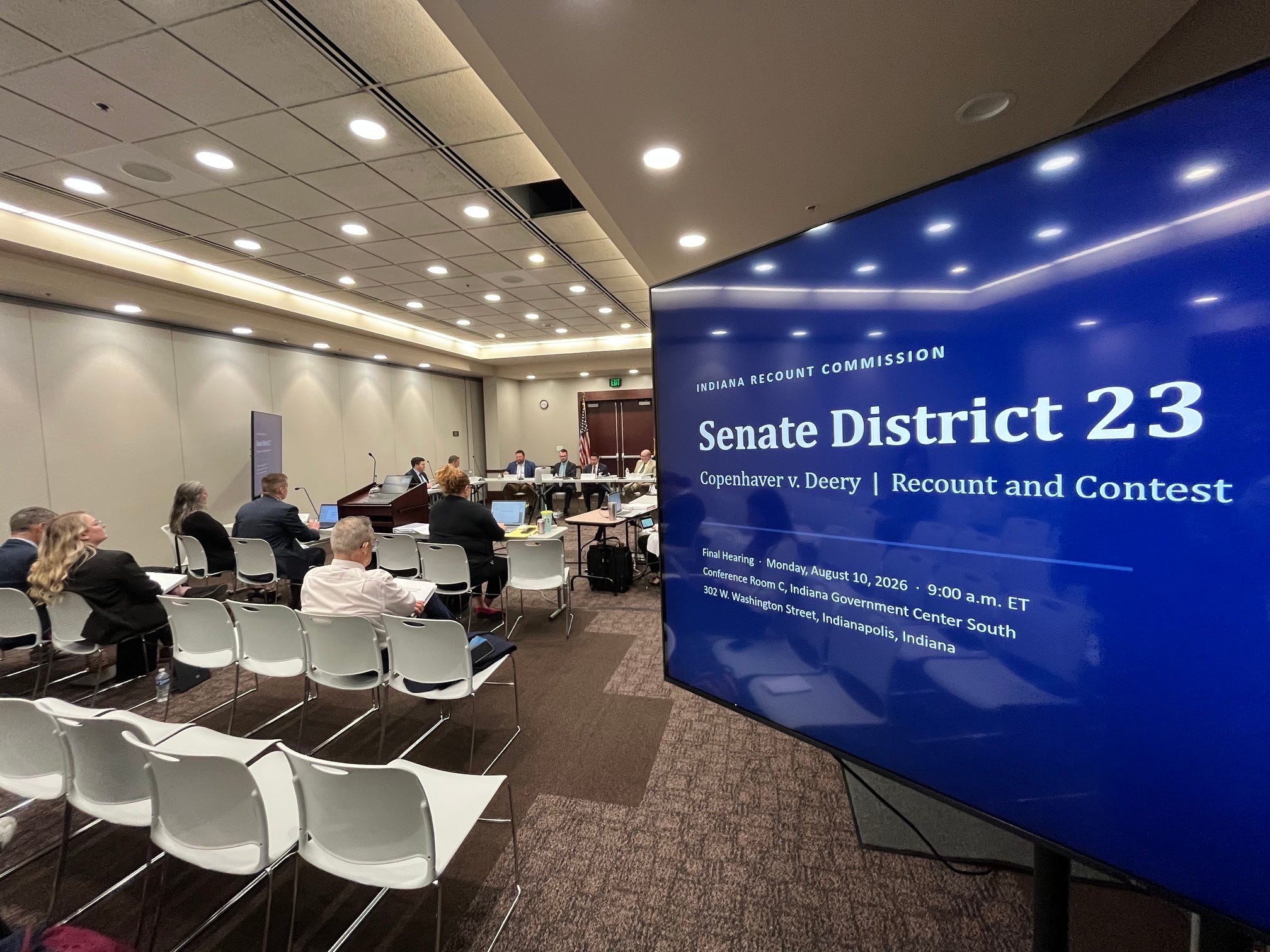
Bill Bock, Copenhaver’s attorney, that day pointed to mistakes in how ballots were handled – whether they had required poll worker initials, or whether a county clerk stamped a seal or signature on a ballot. Deery’s camp argued during the hearing that the tactic threatened to take away votes people cast in good conscience.
The Recount Commission that day rejected 10 votes in the Senate District 23 race. Those included eight for Deery and two for Copenhaver over a combination of missing statutorily required reliability indicators, including the initials of two members of a county’s absentee voter board, the county clerk’s stamped signature and the county clerk’s official seal.
That put the final count in the May 5 primary at 6,332-6,329 for Copenhaver.
Deery’s appeal focused on six of those 10 ballots, all that had been cast for him.
Those ballots – two each in Montgomery, Vermillion and Warren counties – lacked the seal and signature of the county clerk.
Deery and Copenhaver each lost two votes because absentee ballots being challenged didn’t include the required initials of two members of a county’s absentee voter board. The Indiana Recount Commission voted 3-0 in each of those situations, agreeing that state law gave no leeway and that the votes must be rejected.
Deery’s appeal did not challenge decisions on those four ballots.
The other six for Deery were missing either the clerk’s signature or the clerk’s seal.
Michael Claytor, a Democratic member of the Recount Commission, argued during last week’s hearing that the commission had discretion under the law to accept those ballots. In each case, Secretary of State Diego Morales and Republican commission member Paul Mullin voted to reject the ballots, after Bock argued “that Indiana requires high standards to protect the integrity of absentee ballots because absentee ballots are more susceptible to fraud and potential manipulation.”
Those 2-1 votes by the Indiana Recount Commission on those six ballots became the difference in the race.
Deery’s attorney, Karen Celestino-Horseman, argued that the Indiana Recount Commission’s decisions were reversable errors that had disregarded “undisputed intent of those voters to nominate Sen. Deery … through no fault of their own.”

The appeal points to a “savings clause intended to protect against clerk errors such as the omission of the seal/signature, while expressly stating that absentee ballots lacking initials cannot be counties in a recount.”
The appeal points to a provision in Indiana Code that says that a ballot cast by a voter in compliance with state law, other than “the act or failure to act of an election officer,” may be counted in a recount, “unless evidence of fraud, tampering or misconduct affecting the integrity of the ballot is presented by a party to the proceeding.”
During Recount Commission hearings, Copenhaver’s team did not suggest the voters were involved in fraud of misconduct. Bock argued, though, that it was a matter election integrity.
The appeal cites Brown v. Grzeskowiak, a 1959 Indiana Supreme Court ruling that concluded “in the absence of fraud, actual or suggested, statutes will be liberally construed to accomplish this purpose (of the free and fair casting and counting of ballots), so as to uphold the will of the voters and ‘prevent disenfranchisement.’”
The appeal argues that the 2-1 votes on ballots that contained questions about clerk’s signatures and seals leaned on “unbridled discretion” that was “standardless.”
“Such unbridled discretion power would be arbitrary and capricious,” the filing argues.
The appeal argues: “In applying the savings clause, the Commission should have first determined 1) whether the ballot was properly cast by the voter; and 2) whether the problem with the ballot is due to an error of an election official; and 3) whether the challenger satisfied the heavy burden of showing evidence of fraud, tampering or misconduct affecting the integrity of the ballot. If the answer to the first two questions is ‘yes’ and as the Commission found no evidence of fraud, tampering, or misconduct as no evidence of such was presented, the six ballots should not have been subtracted from Deery’s total votes received. Two members of the three-member Commission voted not to count the six ballots without providing any explanation.”
Deery’s appeal also notes that the “saving provision” in state election law also applies in cases when an absentee voter is notified by county election officials and given a chance to recast a ballot when an error is discovered that would lead to the ballot not being counted.
“Here, as the six ballots at issue were accepted and counted, the voters were not given the opportunity to recast their ballot,” the appeal argues.
Deery said Monday that he didn’t consider the appeal a partisan issue, but one “about voter protection and the integrity of future elections.” He included a seventh voter not included in the appeal – one from Fountain County who voted with a provisional ballot after questions about their registration but later supplied the necessary documentation to have the election board count the vote. In that case, the vote was rejected by the Indiana Recount Commission because county officials didn’t add their initials, the clerk’s seal or the clerk’s signature.
“Our appeal aims to protect seven voters who fulfilled their civic duty,” Deery said. “There is no dispute that they were legally registered, and there is no question whom they intended to vote for. They proved their identity, signed their names, and did everything we ask of voters. But their government let them down, and now their voices have been silenced and their votes erased by a politically appointed commission. Silencing these voters is neither lawful nor just. The government must never be able to arbitrarily take away votes because it wants a different result.”
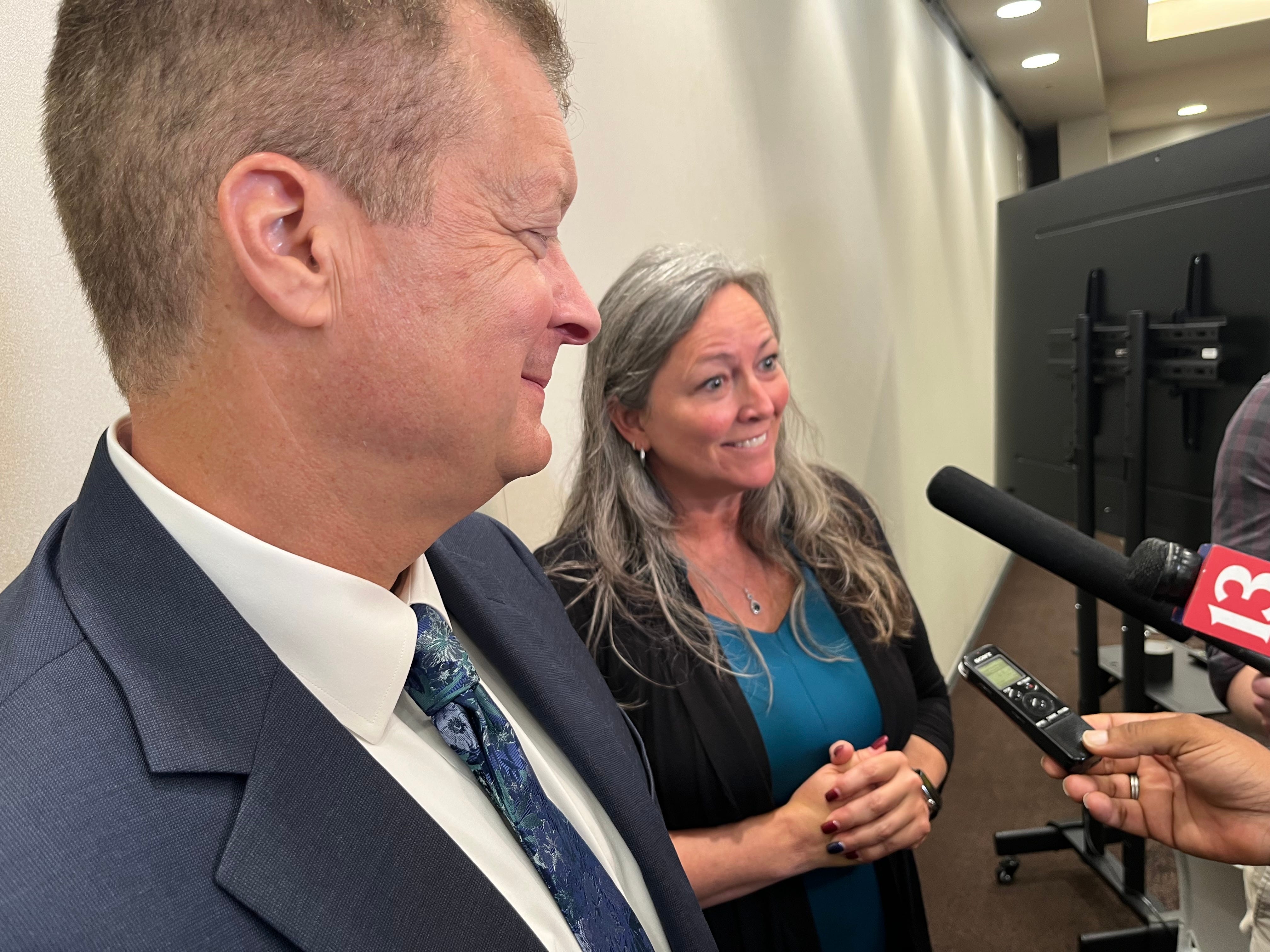
As of now, Copenhaver would be on the Senate District 23 ballot with David Sanders, a Democratic member of the West Lafayette City Council, and independent candidate Joshua Brant.
Barring a successful appeal, Deery would be the sixth of seven state Senate incumbents targeted by Trump who lost in the May 5 primary, after facing attack campaigns that ran into the millions of dollars. Trump and White House allies went all in to get revenge against Indiana Senate incumbents who did not back a push to redraw Indiana’s congressional maps to boost Republican chances to pick up seats in the U.S. House. Deery had been particularly outspoken in his opposition to mid-decade redistricting.
Through that, Copenhaver picked up a Trump endorsement in the primary. Last week, she offered thanks to Trump, along with U.S. Sen. Jim Banks, Gov. Mike Braun and Lt. Gov. Micah Beckwith, who is her boss and was active in recruiting her to run as things went sour on the redistricting plan.
Read the filings
For more coverage


Thank you for supporting Based in Lafayette, an independent, local reporting project. Free and full-ride subscription options are ready for you here.
Tips, story ideas? I’m at davebangert1@gmail.com.
How are voters who cast votes in good faith and legally to know that their vote has been compromised because of no initial by an official or no stamp by the clerk after the fact? They don’t!
I have voted by absentee ballot two times in my life. I followed the law when I submitted my votes.
I would be very upset if my vote didn’t count because of a stupid technicality that was of no fault of my own. Seriously?
Deery should prevail here.
The Supreme Court justices do not need a new job, so perhaps they can correctly interpret plain English.